The price increase of processors has stopped being a warning and is now a fact, at least in two out of the three major players. Intel and Qualcomm have applied increases to several of their CPU families, and AMD would be next on the list with a move of 10%. The detail that matters most to anyone planning a build is the date: the Intel increase expected for October was already executed in September, according to information gathered by the Taiwanese outlet Commercial Times from supply chain sources.
It is worth separating what is confirmed from what remains up in the air. The increases for Intel and Qualcomm are on the table with concrete figures; AMD’s, however, is still a plan without a date.
A price hike already applied in September
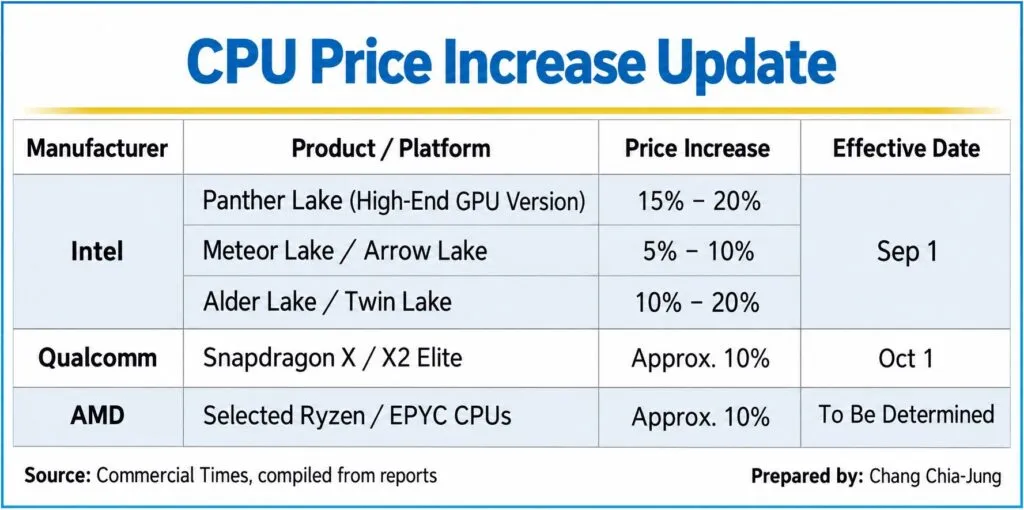
Intel’s price increase did not arrive in the quarter when it was expected. Previous leaks pointed to an increase of up to 10% for October, but the supply chain report holds that it has already happened in September and affects several ranges of processors.
The most affected family is Panther Lake, the company’s high-performance proposal, which would have increased in price between a 15% and 20%. That said, not all its models fall into the adjustment: according to the same report, prices rise mainly on variants with the most powerful integrated graphics, while the rest remain outside the bulk of the increase.
Older tiers are also affected. For Alder Lake and Twin Lake, the report cites ranges of 10% to 20% for some variants and 5% to 10% for entry-level low-power chips. In other words, the range is not uniform: it depends on the model and its placement in the catalog.
Qualcomm raises its PC platforms from October 1
Qualcomm has not been left behind. The company reportedly applied an increase of approximately 10% to its PC processor platforms, which includes the Snapdragon X and X2 Elite families. Here the date is precise: the adjustment took effect on October 1.
The move fits with the momentum being lived by the ARM architecture PC segment, where these platforms compete directly with x86 proposals from Intel and AMD.
AMD, the possible third move
The third manufacturer has not yet made its move, but reports place it at the starting line. AMD would be preparing a price increase of around 10% that would hit some families of Ryzen and EPYC, its server line.
What is missing is precisely what most conditions a purchase decision: the date. It is not clear when AMD’s new price would take effect. Given that Intel and Qualcomm have already applied theirs and demand remains high, the forecast handled by consulted media outlets is that the announcement will be made soon, without ruling out a delay.
TSMC is at the root of the price hike
Behind the three hikes is the same supplier: TSMC, the Taiwanese foundry that manufactures chips for Intel, Qualcomm and AMD. According to the Central News Agency (CNA), the company would raise its manufacturing prices again in 2027, and industry analysts anticipate hikes of 5% to 10% for advanced nodes, 10% to 15% for advanced packaging and 3% to 5% for mature nodes.
To that manufacturing cost increase is added the escalation in the cost of high-performance memory and storage, which adds pressure to the final price. It is the same dynamic going through the rest of hardware: it’s not that a manufacturer decides to raise prices just because they want to, but that the entire chain is more expensive underneath.
What changes if you are building or buying
For anyone building a system, the practical takeaway is that reference prices are already moving and it is not advisable to keep waiting for them to drop. With double-digit increases, the effect is more noticeable on expensive parts: the same percentage weighs much more heavily on a high-end processor than on an entry-level one.
The sensible thing to do, if you have a configuration decided upon, is to lock in the price as soon as possible and watch for specific deals rather than waiting for drops that don’t come. And if the build can wait, it is advisable to check which specific models fall into the adjustment: since the hike isn’t uniform, the part you have in mind might be spared or the surcharge might push it out of budget. Before buying, compare the price of your target CPU with what it was a few weeks ago: that will show at a glance if it has been hit by the increase.