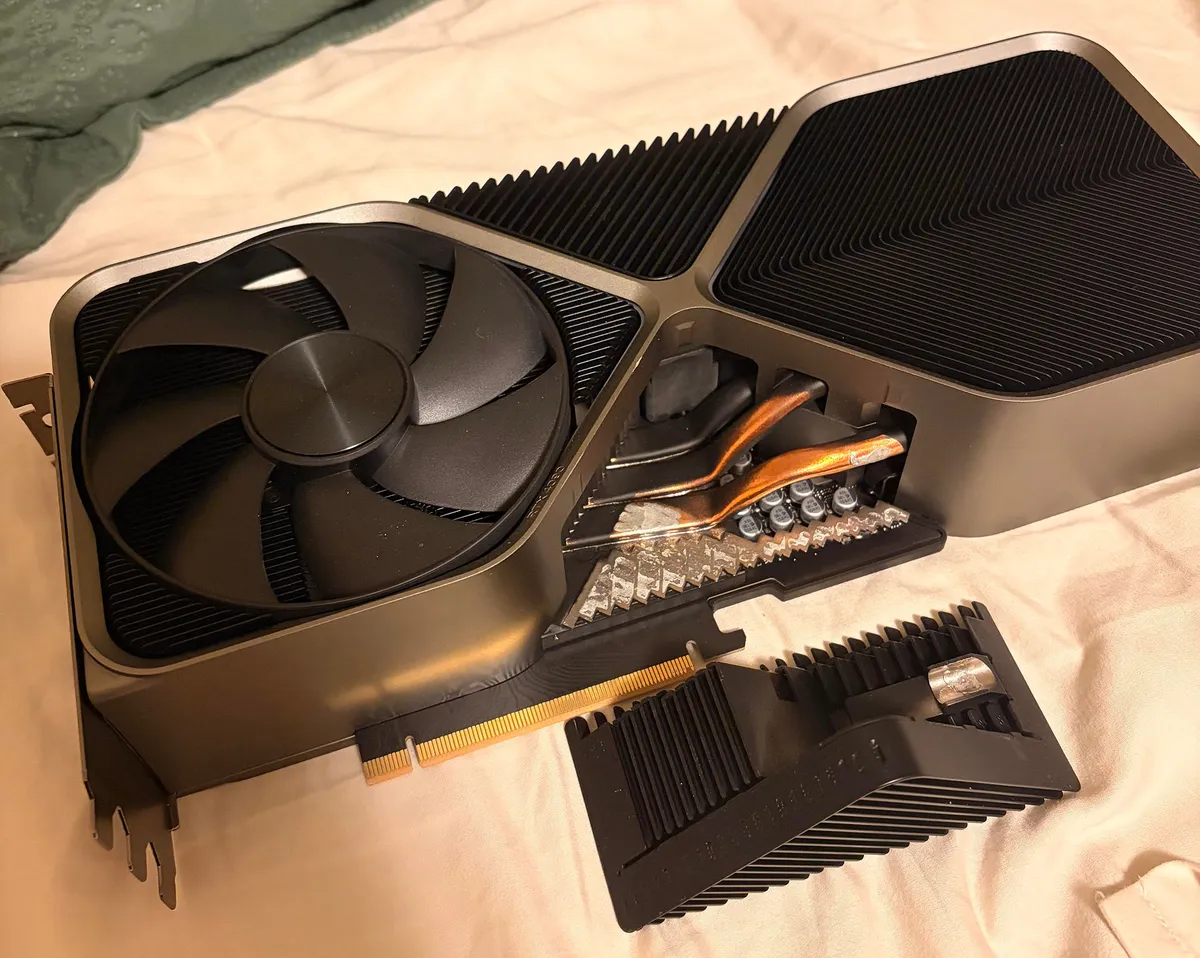
An owner of a GeForce RTX 4090 Founders Edition has documented an unusual failure: one of the triangular blocks of aluminium fins on its heatsink came loose while he was moving the PC. It is not a decorative shroud, as often happens on custom cards, but a part of the cooling system NVIDIA designed itself. The shared photos show the heatpipes that held that block exposed and, according to the account relayed by El Chapuzas Informático from the original Reddit thread, it would be the first time such a case has been recorded.
A heatsink block comes loose on the RTX 4090 Founders Edition
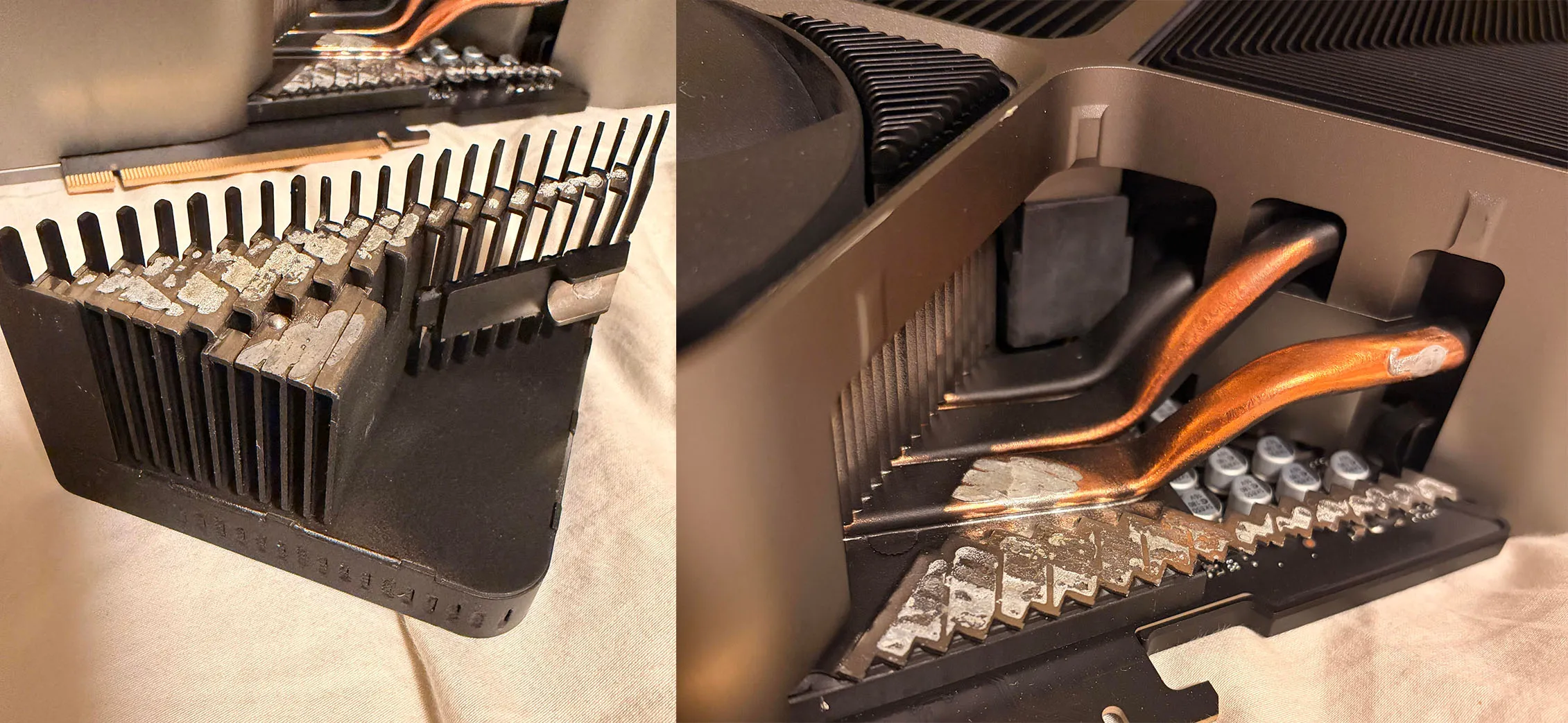
The affected owner posted the images in the r/nvidia subreddit and said the block gave way as he shifted the machine. The photos show a sizeable section of the aluminium fins separated from the rest of the heatsink, with the heatpipes that ran through the area visible. There is no prior record of an equivalent detachment either on the Founders Edition or, for all practical purposes, on any other GPU model, as the outlet reports.
The unit was bought in August 2023, so the failure shows up after roughly three years of use. The owner contacted NVIDIA when he found it, but the problem is that the card sat just days beyond its three-year warranty.
A warranty lapsed by days and repairs over 400 dollars
With no manufacturer coverage, the affected owner is looking for a sensible way to repair the card. By his account, some services specialising in GPU repair can charge more than 400 dollars for this kind of work, an amount that in many cases comes close to the market value of the product itself.
It is worth separating two things: NVIDIA’s commercial warranty, which is what has expired, and the legal guarantee of conformity that in Spain covers the purchase before the seller for the periods set by law, regardless of the terms the brand imposes. The manufacturer closing the door does not necessarily exhaust every option for the buyer, though the real headroom depends on how much time has passed. Cases such as the RTX 5090 that burned out at idle and had its warranty denied show that the manufacturer’s answer does not always match what the buyer expects.
No official explanation: thermal cycling and cracks as the hypothesis
For now there is no sign that this is a widespread problem on RTX 4090 Founders Edition cards. In the community itself, several owners say they have never seen anything similar, and NVIDIA has offered no official explanation of what happened for this unit to literally lose a chunk of aluminium.
The most repeated hypothesis points to the joint between the fins and the heatpipes. Some users argue the part would be soldered and that the many heating and cooling cycles accumulated over the years could have created small cracks, until the movement of the PC finished forcing the detachment. It is a plausible explanation, but unconfirmed: only NVIDIA could issue a definitive diagnosis, and so far it has not.
The card can keep working: thermal adhesive or re-soldering
Losing the part does not mean the GPU has stopped working. The detached block added surface area to dissipate heat, while the heatpipes still run through other parts of the heatsink. In practice, the only difference should be temperatures, a figure the owner has not disclosed, so the thermal penalty is probably not dramatic.
To recover efficiency, the simplest route is to reattach the part with epoxy or a thermally conductive adhesive, something the affected owner has considered himself. His doubt is fair: that the adhesive’s conductivity is lower than the original joint and ends up hurting temperatures. The more delicate alternative is to fully disassemble the card and re-solder the aluminium block, an operation that, much like an RTX 4090 heatsink fitted onto an RTX 3060, takes careful work for the gain to justify the risk. In most cases, re-soldering is not that far ahead of a good thermal adhesive.