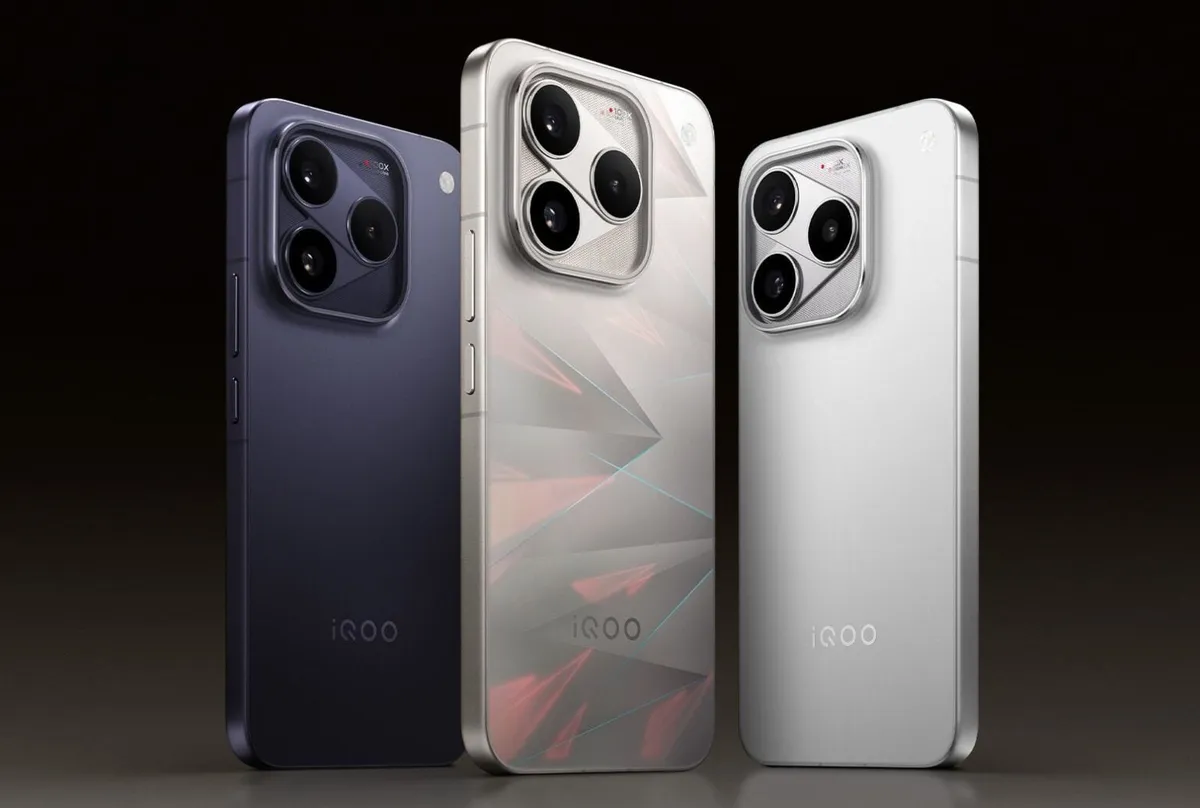
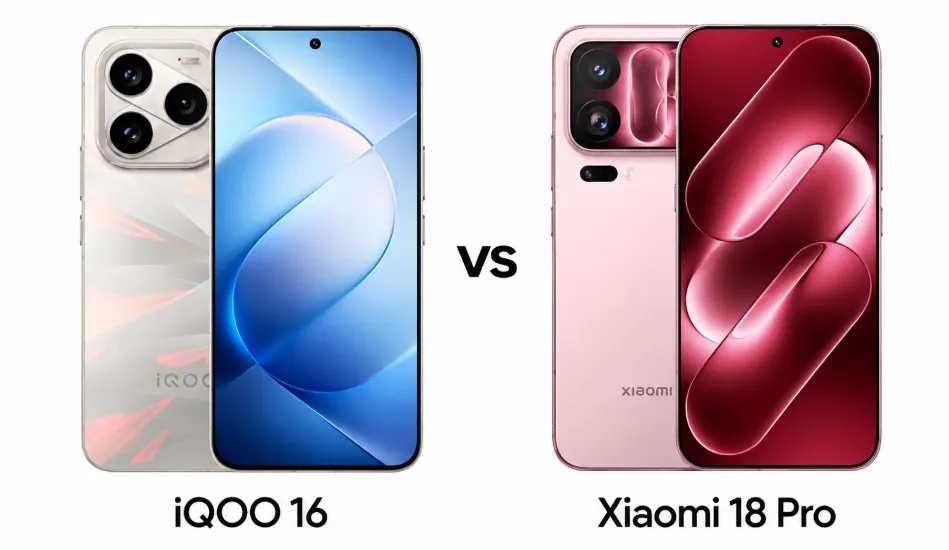
The iQOO 16 and the Xiaomi 18 Pro arrive with the same foundation —Android 17, up to 16 GB of RAM and up to 1 TB of UFS 4.1 storage— and with opposite priorities. The iQOO sits around 800 dollars (roughly 83,000 rupees in India) and the Xiaomi 18 Pro around 1,000 dollars (roughly 120,000 rupees). This comparison separates what really changes the day-to-day experience and ends with a verdict by profile: there is no universal winner, there is a right phone for each type of buyer.
Display: 6.85 inches at 165 Hz versus a 6.4-inch LTPO panel
The iQOO 16 carries a 6.85-inch AMOLED panel with 1440 × 3168 resolution, 165 Hz, Dolby Vision and HDR10+. The Xiaomi 18 Pro opts for a 6.4-inch LTPO AMOLED, 1120 × 2436 and 120 Hz, also with Dolby Vision and HDR10+.
The practical difference runs along two axes. The first is size: 6.85 inches favour video consumption and gaming, while 6.4 inches are easier to handle with one hand. The second is refresh rate: the iQOO claims 165 Hz and the Xiaomi stops at 120 Hz, although its LTPO panel adjusts the frequency adaptively to use less battery.
The peak brightness both manufacturers advertise —10,000 nits on the iQOO and 4,000 on the Xiaomi— are marketing figures. What matters is sustained brightness outdoors, and that can only be checked with the phone in your hand.
Chip: same generation, different position
The iQOO 16 uses the Snapdragon 8 Elite Extreme Gen 6 with an Adreno 850 GPU; the Xiaomi 18 Pro uses the Snapdragon 8 Elite Gen 6. On paper, the iQOO occupies a higher position within the family, which should show up in demanding games and heavy graphics workloads.
It is worth tempering expectations: sustained performance depends on cooling and on how each manufacturer optimises. The original analysis itself warns that the real advantage can only be measured with independent performance and temperature tests, which were not available when this guide was written. For demanding applications, multitasking and high-end games, both are more than capable.
Cameras: the argument that justifies the price
This is where the distance is clearest. The Xiaomi 18 Pro has a 200 MP main sensor with optical stabilisation and Leica optics, a periscope also rated at 200 MP with 3.2x optical zoom, and a 50 MP ultrawide with autofocus, laser focus and a colour spectrum sensor. It records 8K at 30 fps and 4K at 120 fps, with HDR and LOG options.
The iQOO 16 answers with a more conventional setup: a 50 MP main camera with stabilisation, a 50 MP periscope with 3x optical zoom and a 50 MP ultrawide with autofocus. It records 8K at 30 fps. Its front camera is 32 MP; the Xiaomi’s is 50 MP with autofocus.
The Xiaomi’s 2.7-inch rear display adds a concrete advantage for people who photograph themselves: it lets you frame selfies with the main camera or the telephoto instead of always using the front one. For photography and video, the Xiaomi is the more ambitious phone; for everyday use, the iQOO does the job without trouble. If you want the details of the Xiaomi handset, the Xiaomi 18 Pro launch coverage goes over its rear screen and the rest of its spec sheet.
Battery and charging
The iQOO 16 packs an 8,400 mAh silicon-carbon battery, with 100 W wired charging, 40 W wireless and bypass charging, which powers the phone directly during gaming sessions so the battery is not punished.
The Xiaomi 18 Pro drops to 7,000 mAh, also silicon-carbon, with 100 W over the cable, 50 W wireless and 27 W reverse wireless charging. It wins on convenience for accessories; it loses on raw capacity.
More milliamp-hours do not automatically mean more endurance: panel and software consumption weigh in. Even so, the 1,400 mAh gap is large enough that the iQOO starts with an advantage among people who spend many hours away from home.
Software: a draw on Android 17
Both ship with Android 17: OriginOS 7 on the iQOO and HyperOS 4 on the Xiaomi. The original comparison considers it a draw, and in practice the choice depends on the layer each user prefers. Neither of the two documents details the update commitment, so it is worth confirming with the manufacturer or the store before paying, because it is a factor that affects how long the phone stays useful.
Price: what separates the iQOO 16 from the Xiaomi 18 Pro
The gap is about 200 dollars: 800 versus 1,000. For that money, the Xiaomi adds the Leica system, the 200 MP sensors, 4K recording at 120 fps, the rear screen, 50 W wireless charging and 27 W reverse charging. The iQOO concentrates its budget on a fast display, a large battery, bypass charging and IP68/IP69 water resistance.
Both prices are approximate and vary by country, taxes and the moment of purchase. Before deciding, check whether the unit you are offered is the Chinese or the global version: bands, accessories and warranty change.
Verdict by profile
- Gamer or heavy user: iQOO 16. The 165 Hz display, the 8,400 mAh and bypass charging are designed for long sessions.
- Photography and video: Xiaomi 18 Pro. The 200 MP with Leica, 4K at 120 fps and the rear screen make the difference.
- Anyone looking for a compact phone: Xiaomi 18 Pro, at 6.4 inches versus 6.85.
- Best value for money: iQOO 16, unless the camera is a real priority.
What each one gives up and when it is not worth it
The iQOO 16 gives up the Leica system, the 200 MP sensors, 50 W wireless charging, 27 W reverse charging, UWB, video output over USB-C and the rear screen. If you take a lot of photos or record video with your phone, that cut is noticeable.
The Xiaomi 18 Pro loses battery capacity, refresh rate and the rival’s IP69 rating, and costs about 200 dollars more. If you are not going to use the camera beyond the basics or the rear screen, that premium buys nothing you will take advantage of.
How to check before paying
- Confirm in the seller’s listing whether the model is the Chinese or the global version.
- Check the final price with taxes included, not the advertised dollar figure.
- Review which charger comes in the box and whether it supports the fast charging the manufacturer advertises.
- Ask about the Android update policy, which neither spec sheet details.
- If the camera is your main reason, ask for photo and video samples before closing the purchase.
With those checks done, the decision comes down to one question: do you pay 200 dollars more for a clearly superior camera system and a rear screen, or do you keep more battery and a faster display for less money?