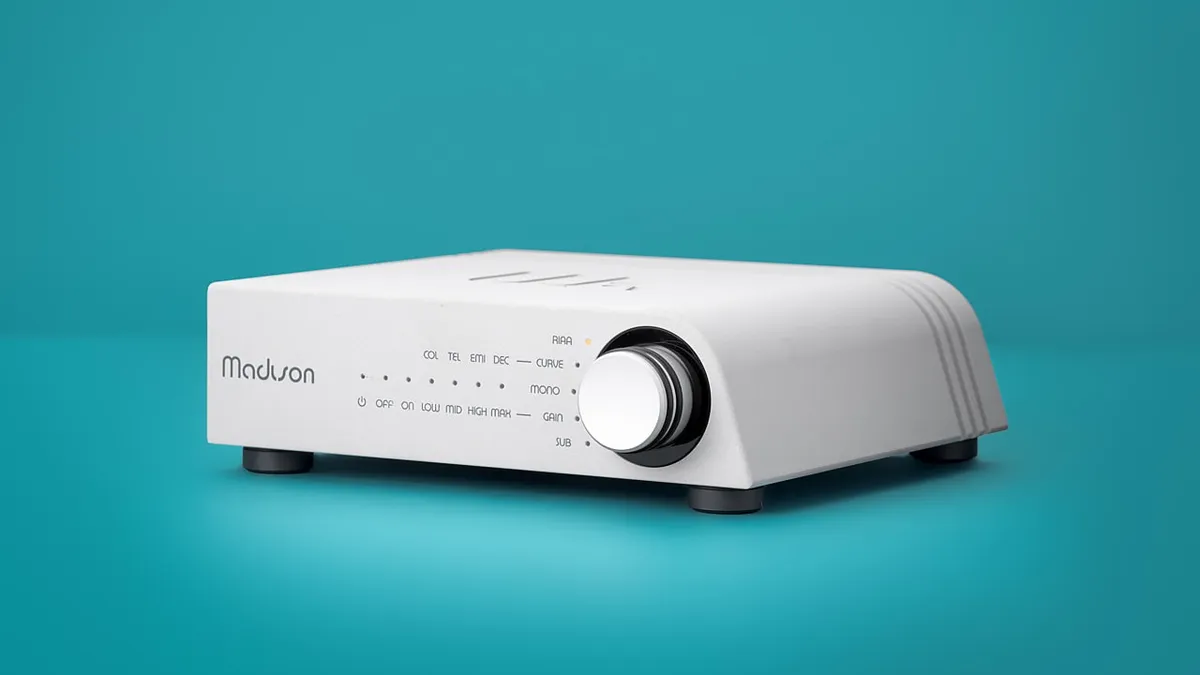
Wattson Audio has introduced the Madison Phono, a Swiss-made phono preamp costing $5,495 that converts the cartridge signal to 32-bit/384 kHz before applying equalization in the digital domain. The idea of digitizing vinyl is not new: Linn itself already demonstrated with its Urika II that digital RIAA correction can work well. What changes in Wattson’s approach is that it does not treat all cartridges as variations of the same electrical problem.
Madison Phono: a compact preamp with high-resolution conversion
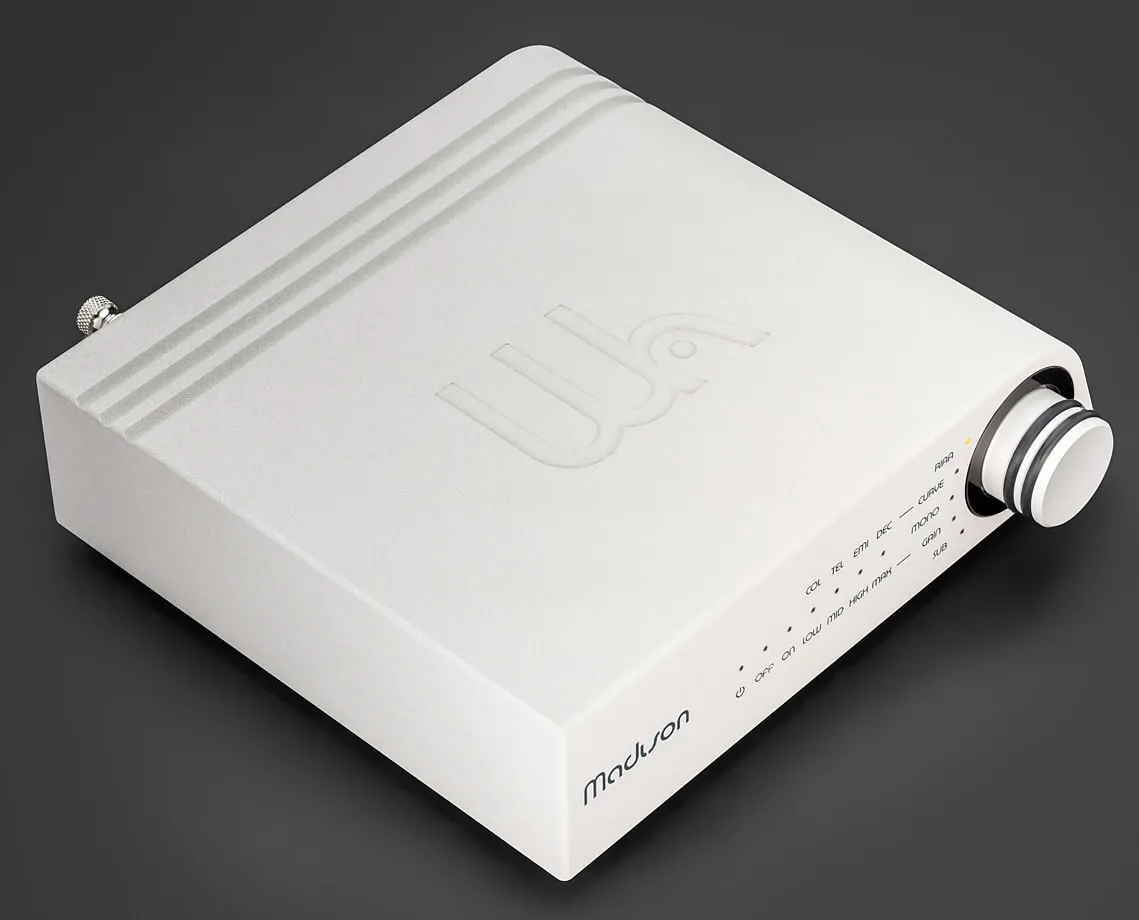
The chassis measures 175 x 185 x 52 mm and weighs 1.7 kg, considerably less than most high-end phono preamps. The input circuitry is indeed specific for each capsule type; from there, the amplified signal is converted to 32-bit/384 kHz and filtering and equalization are resolved digitally.
From the factory, it includes RIAA, Columbia, Teldec, EMI, and Decca curves, which Wattson cites as a precision of ±0.1 dB. It is a manufacturer claim, not an independent measurement, but it marks the product’s argument: several historical curves implemented with repeatability that in the analog domain is much more difficult to guarantee.
Three interchangeable input boards
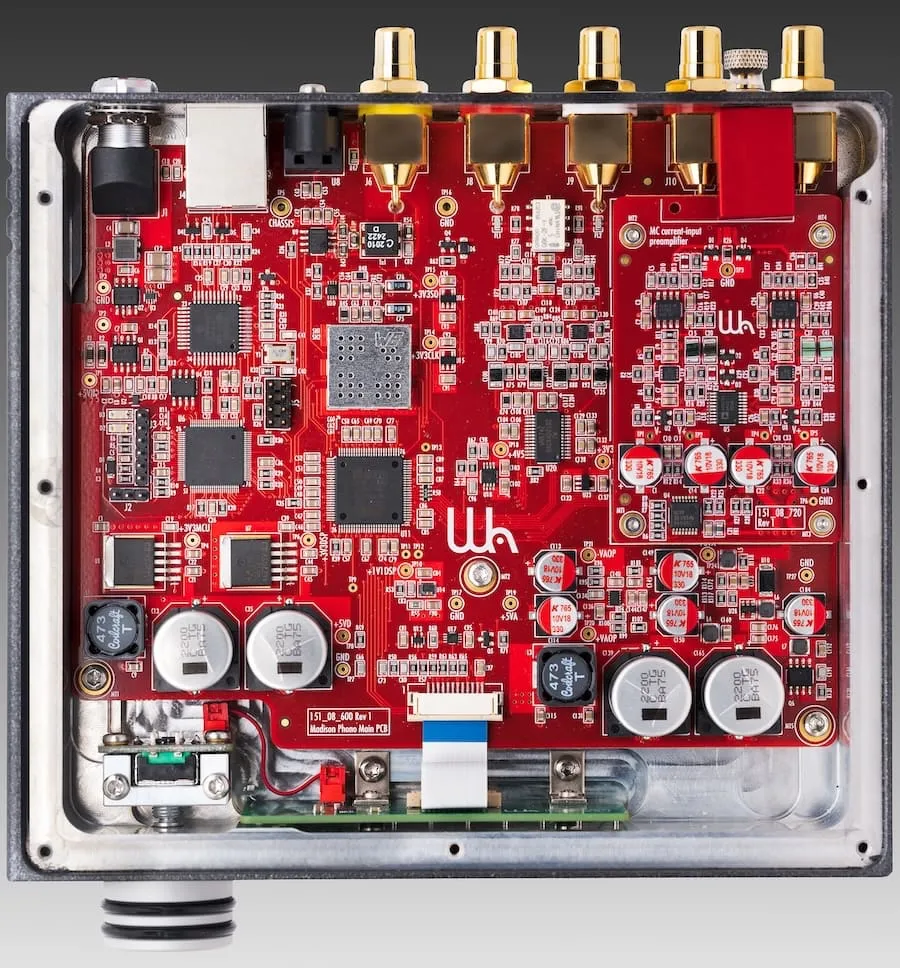
The most singular part of the Madison Phono is that each unit is ordered with one of three replaceable input boards:
- Voltage: for moving magnet (MM) and higher impedance moving coil (MC) capsules.
- Current: designed for low impedance MCs, with an active transimpedance amplifier derived from CH Precision technology.
- Optical: designed for DS Audio photoelectric cartridges, also with active transimpedance topology.
Each additional board costs $500 and can be changed later if the owner migrates to another cartridge technology. On paper, this matters more than it seems: most preamps offer different gain and load values on the same input architecture, whereas here the entire input stage changes depending on how the cartridge generates the signal.
Why digitize vinyl
Wattson’s reasoning is direct: taking RIAA correction out of the analog stage eliminates large passive equalization networks and allows applying several curves with much greater repeatability. The analog amplification section can thus remain linear instead of handling both gain and equalization at once.
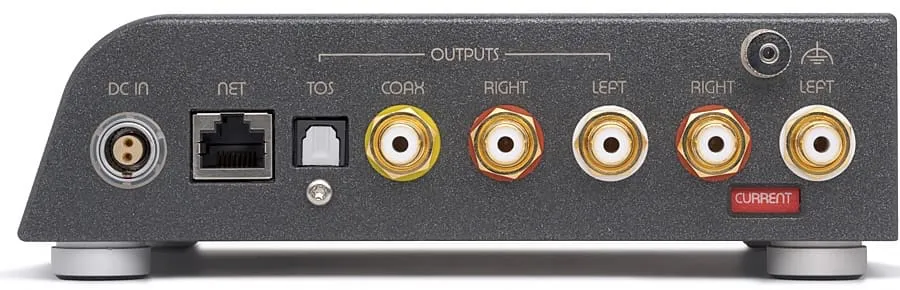
The signal can exit via conventional analog RCA outputs or stay digital through coaxial S/PDIF or optical up to 192 kHz, with optional reduction to 96 kHz. That makes it interesting in systems built around a DAC or a quality digital preamp: whoever uses the Madison Streamer from the same house can keep the vinyl signal in digital after the phono preamp instead of immediately re-converting it to analog.
Who is it for and what does it compete against
The Madison Phono fits best for someone who already has a serious turntable and cartridge, as well as a system centered on the digital, such as active speakers PSB iQ2 that we have already analyzed. A collector with old pressings from Columbia, Decca or EMI accesses the corresponding historical curves; whoever uses a low-output MC can opt for current-mode amplification without the conventional cartridge load; and a DS Audio owner enters optical reproduction without buying a separate equalization platform. If they change cartridge technology, they do not end up with an expensive aluminum paperweight.
Among the preamps we have covered, none replicates the complete architecture. The MoFi Electronics MasterPhono ($5,995) is a fully analog balanced MM/MC preamp, with voltage and current inputs and much load flexibility. The Aavik R-x88 series supports MC and DS Audio optical cartridges but starts at $20,000, does not offer MM, and maintains a conventional analog path. The Backert Labs Optik Phono 1.1 ($11,500) also supports DS Audio, although it is a dedicated optical equalizer and not a multi-format preamp.
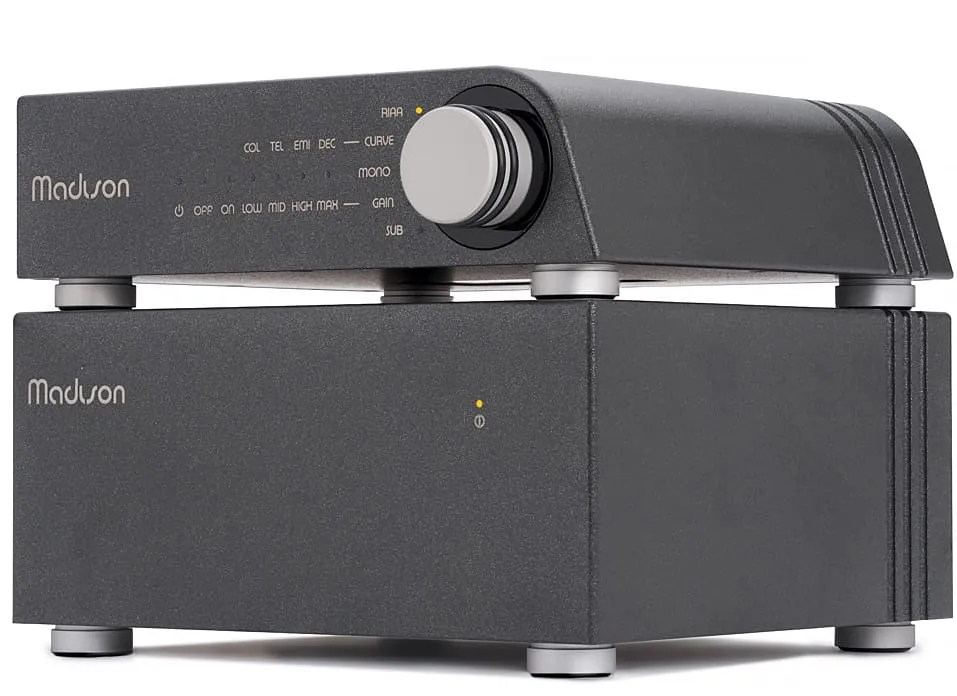
The appeal of the Madison Phono does not lie in digitizing vinyl, but in bringing together MM, MC in voltage mode, MC in current mode, DS Audio optical support, interchangeable input boards, historical curves, and analog and digital outputs in a single compact and updatable box. It is less a conventional phono preamp and more a bridge between serious analog reproduction and current digital systems. Whoever thinks an analog-to-digital converter (ADC) should not approach a turntable will not buy it; for the rest, it solves in one piece of equipment what normally requires several.