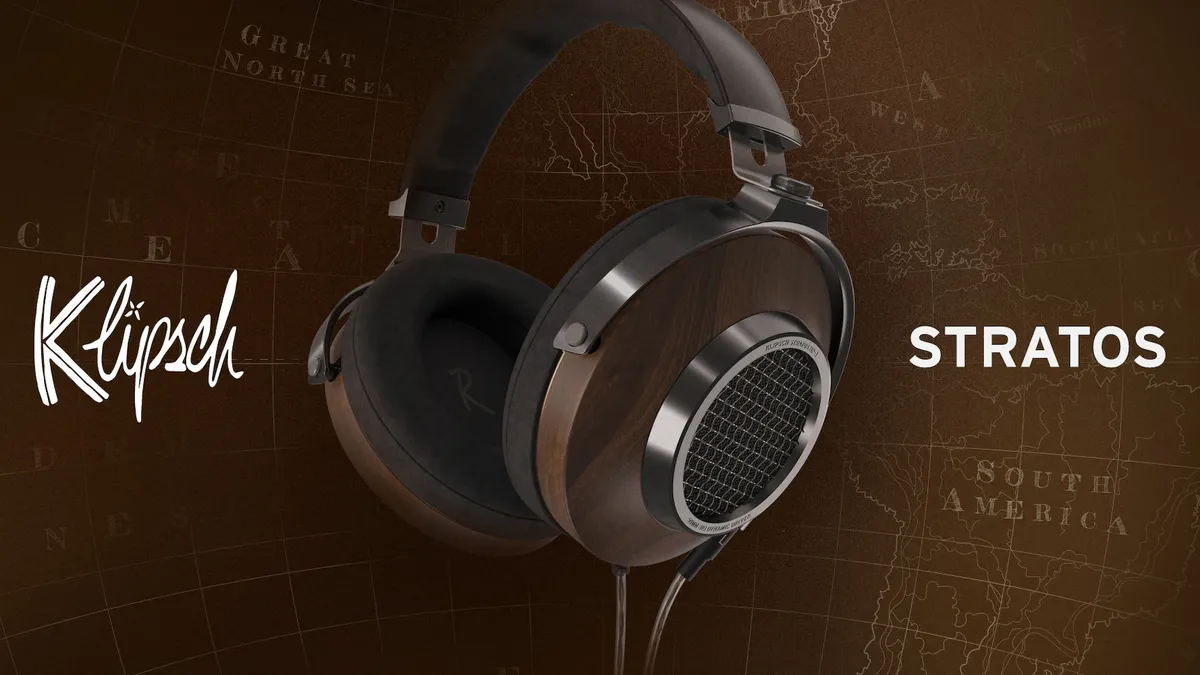
The Klipsch Stratos arrive in two versions, HP-2 and HP-3, priced at €999 and €1,199 for Europe and shipping in January 2027. In the United States they will be available earlier, in December, for $999.99 and $1,199.99. The brand presented the series at CanJam Dallas on 14 and 15 November, as part of its 80th anniversary, and did so with a decision that is unusual in the current segment: these are wired over-ear headphones, with no Bluetooth and no smart features.
The commitment to materials is explicit: cups made of real dyed sapeli wood, machined aluminium parts and copper details. But it is worth separating what the manufacturer claims from what it has not yet demonstrated, because those are two different things.
Coaxial two-way drivers: the acoustic argument
The HP-2 is a closed design and mounts a 40 mm biocellulose driver for mids and bass plus a 10 mm dynamic tweeter. The HP-3 is semi-open and moves up to a 50 mm driver, with the same 10 mm tweeter. In both cases the two emitters are mounted on the same axis, a coaxial configuration that is rare in headphones: the idea is that bass and treble come from the same point and behave as a single source, which helps keep the stereo image from falling apart in the crossover region between drivers.
| Spec | Stratos HP-2 | Stratos HP-3 |
|---|---|---|
| Enclosure | Closed | Semi-open |
| Drivers | 40 mm biocellulose + 10 mm | 50 mm biocellulose + 10 mm |
| Response | 15 Hz–18 kHz (±5 dB) | 16 Hz–22 kHz (±5 dB) |
| Impedance | 32 ohms | 24 ohms |
| Sensitivity | 100 dB | 102 dB |
| Distortion (THD) | <0.1 % at 1 kHz | <0.15 % at 1 kHz |
| Power handling | 30 mW | 30 mW |
| Weight | 380 g | 458 g |
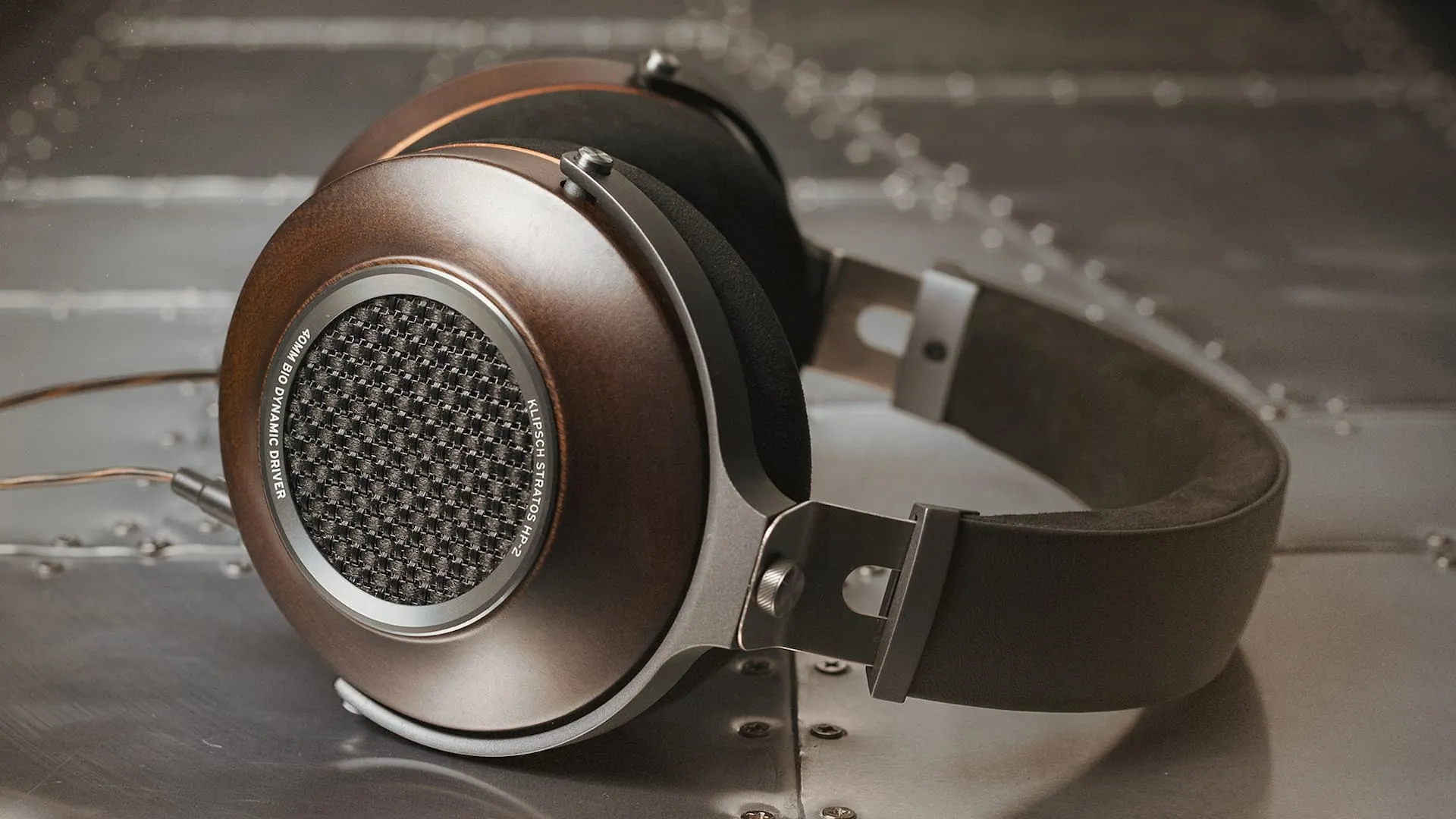
The HP-3’s 24 ohms and 102 dB place it in the range of headphones a phone can drive comfortably in terms of volume, something Klipsch confirms by stating compatibility from phones to dedicated amplifiers. That said, driving with volume and controlling well are not the same thing: low impedance calls for sources with current capability, and there a desktop amplifier such as the FiiO CLASS A has more headroom than a phone’s output.
The wood in the Klipsch Stratos: finish and brand continuity
Klipsch attributes no acoustic property to the wood in its presentation. What it says is that the cups are made of dyed sapeli, that the yokes and contact points are machined aluminium, and that the ensemble aims to resemble its Heritage series speakers, with the house’s Twitchell fabric and copper rings as a detail. The sonic argument the brand does stand behind is the coaxial drivers, the high efficiency and the low distortion; wood appears in the chapter on finishes and durability.
That does not mean it is irrelevant. A rigid cup with sufficient mass can help control resonances of the enclosure itself, and wood is a reasonable material for that. But to assert it with data you would have to compare two identical cups made of different materials and measure the response and distortion of each. Klipsch does not publish that comparison, so at this point the wood is, for now, aesthetics and craft: nothing to sneeze at in a category where the object is touched and looked at, but not an argument that can be verified.
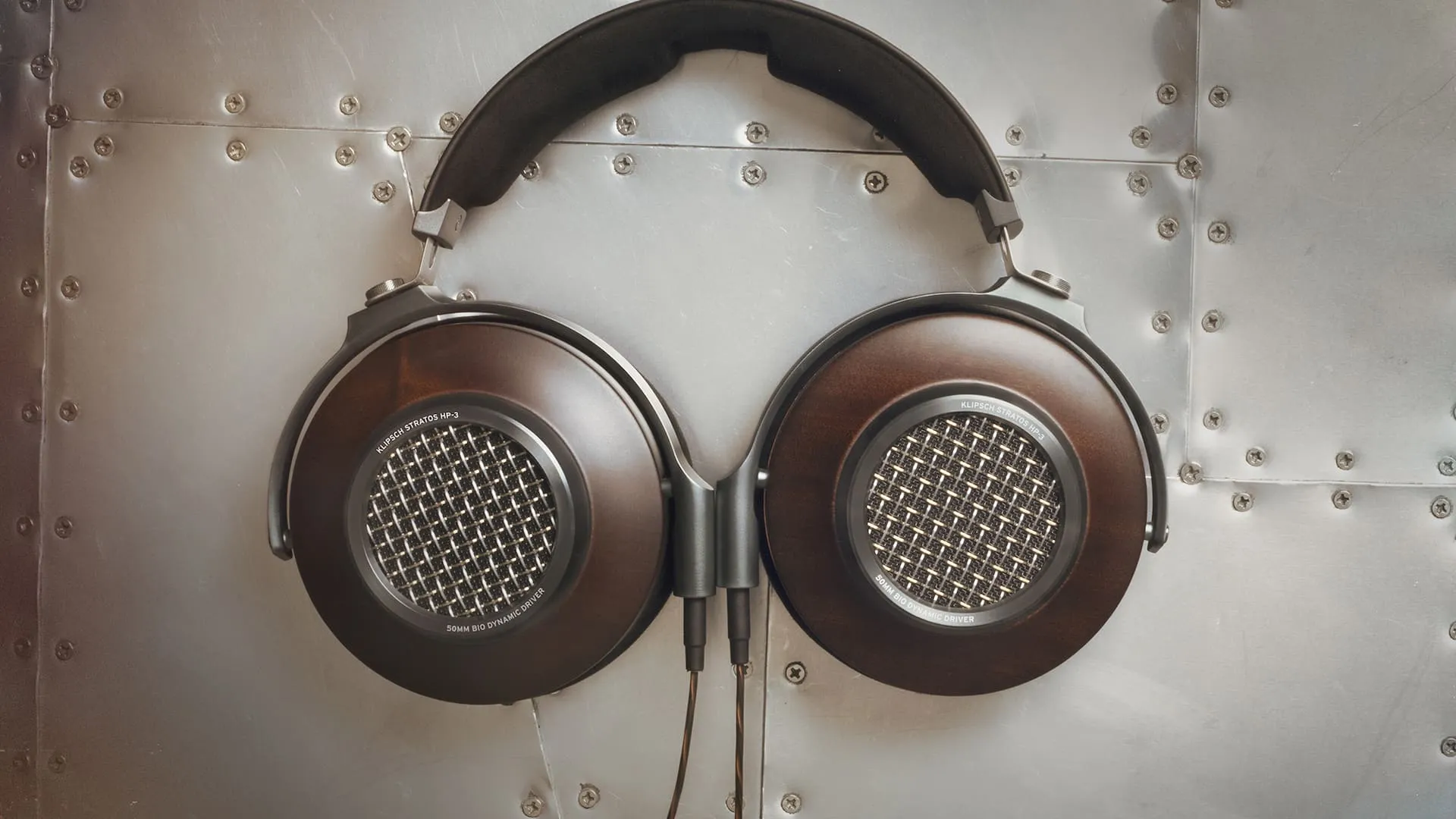
The rest of the ensemble is designed for long sessions: a protein leather headband with open-cell foam and a central opening to distribute pressure, and microsuede earpads held by magnets that can be changed without tools. Weight is the point to watch: 380 g on the HP-2 and 458 g on the HP-3, high figures that can only be judged together with the clamping force, a figure the spec sheet does not include.
What is still missing
The published information gives a sense of the product, but it does not allow you to anticipate how it sounds. Several things that are customary among competitors in this range are missing:
- Full response curves. The spec sheet gives a ±5 dB window, not a graph. Without it, there is no way to know whether the deviation is at the extremes or in a specific band, which is decisive in a headphone at this price.
- Distortion by band. The THD figure is given only at 1 kHz. That is the usual reference point, but it says nothing about how the bass driver behaves at high volume.
- Impedance curve. The HP-3 specifies 24 ohms nominal; without the curve you cannot know whether that figure stays stable or rises in the bass, which changes behaviour with valve amplifiers.
- Measurement conditions for sensitivity. Klipsch does not specify whether the 100 and 102 dB are per milliwatt or per voltage, and the difference between the two references is large when comparing with other models.
- Isolation on the HP-2. The brand describes “excellent” isolation for the closed model, without any attenuation figure.
- A typo in the HP-3 spec sheet. The manufacturer’s table lists a response of “16 Hz-22 Hz”, almost certainly an error for 22 kHz, because the HP-2 reaches 18 kHz and a 22 Hz ceiling would make the higher model unusable.
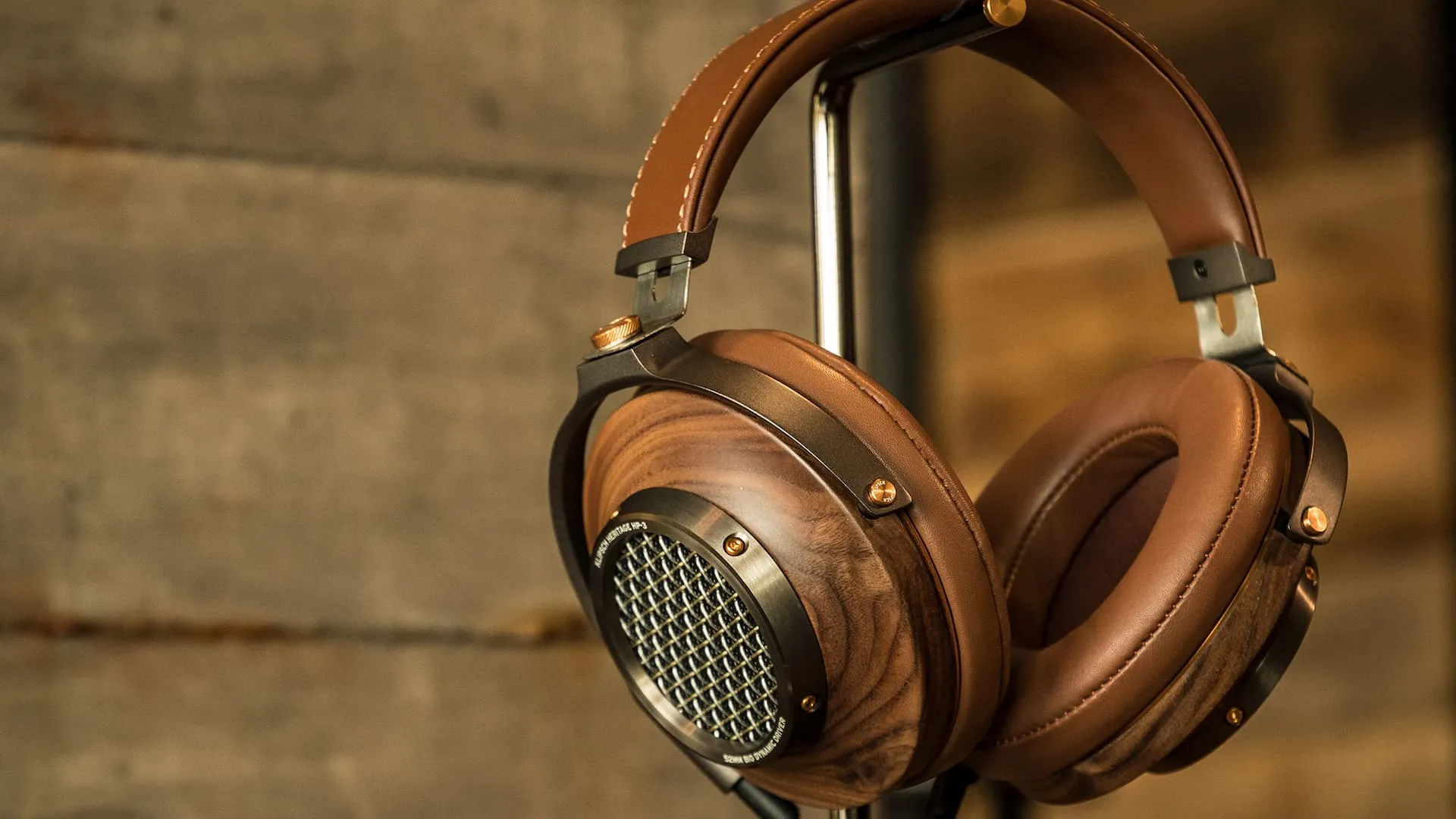
In the box there are two detachable braided nylon cables — one 3.5 mm and 2.5 metres long, unbalanced, and another 4.4 mm and 1.37 metres, balanced, both dual mono — plus a 3.5 mm to 6.35 mm adapter. There will be a single finish, Auburn, and an optional walnut veneer stand with copper details for $149.99 in the United States.
Is it worth waiting for January?
At €999 and €1,199, the Stratos sit in the league of high-end closed and semi-open over-ear headphones, a field where the competition has been publishing measurements for years and where buyers can compare curves before spending. Klipsch arrives with an uncommon proposition in materials and driver architecture, but without data that would let it be placed against its rivals. The reasonable decision, until independent reviews exist, is to treat them as a design and brand bet, not as a measurable improvement.
Klipsch itself has already announced that in early 2027 it will unveil the Stratos HP-1, the third model in the family and the only wireless one. Anyone looking for battery life will have to wait for that date; anyone who wants a cable, wood and a two-way coaxial has an appointment in January.