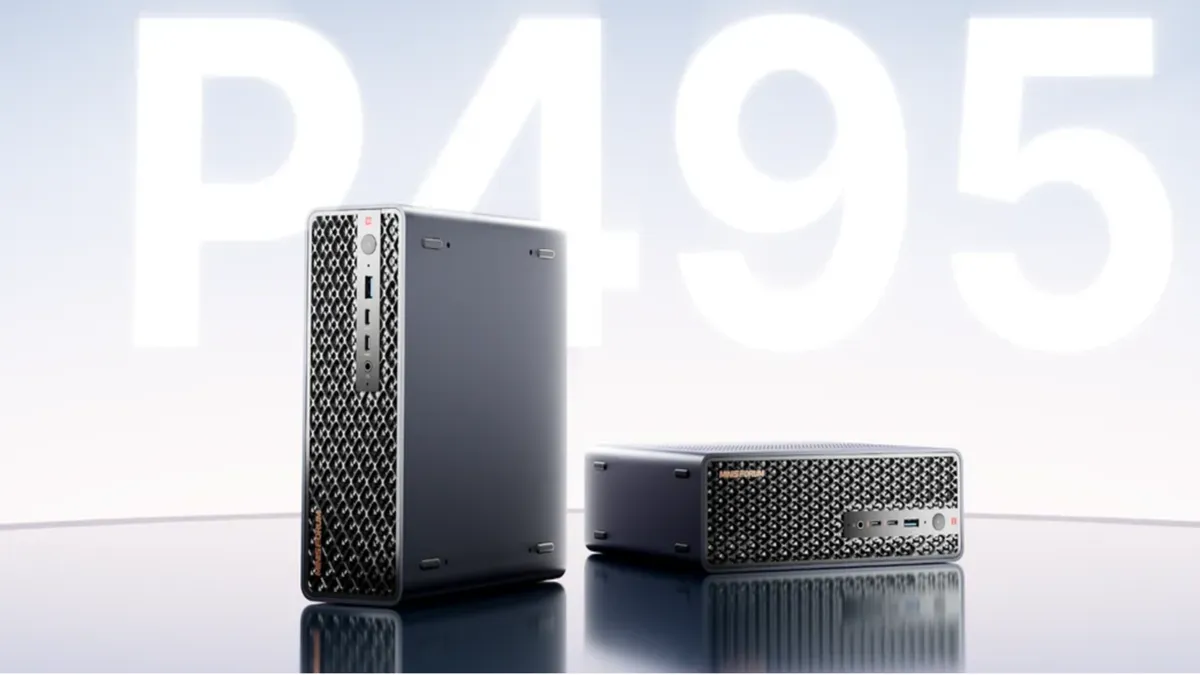
Minisforum is entering the Gorgon Halo segment with the MS-S1 MAX-P495, a compact workstation that pairs AMD’s Ryzen AI Max+ PRO 495 with 192 GB of unified memory and 2 TB of storage. The company is offering it for $7,399 during a limited-time preorder promotion, against its $9,249 list price. According to the manufacturer, shipments would begin around mid-October 2026 in the United States.
The launch price puts this machine in the same league as other systems built around the same processor: the HP ZBook Ultra G3a, calculated at $7,449, and GMKtec’s EVO-X5 Pro mini PC, which lands at $6,399 under its own launch promotion. Framework, Acemagic and Chuwi have also announced systems with this chip recently. Minisforum’s difference is not in the processor spec sheet, but in the form factor and expandability.
A Ryzen AI Max+ PRO 495 with 192 GB of unified memory
At the heart of the machine is AMD’s Ryzen AI Max+ PRO 495, with 16 Zen 5 cores, 32 threads and maximum clock speeds of 5.2 GHz. It is joined by 192 GB of LPDDR5x memory at 8,533 MT/s soldered to the platform, plus a 2 TB SSD for local work.
On the graphics side, Minisforum relies on the Radeon 8065S based on RDNA 3.5, while the integrated NPU handles artificial intelligence workloads. The manufacturer puts combined AI performance at up to 131 TOPS, of which up to 55 TOPS come from the NPU itself.
The company also says two 192 GB systems can work together as a compact AI cluster, with the Qwen3.5 397B model reaching, according to its figures, 16 tokens per second locally.
Expandability, cooling and operating modes
For builders, the key point is that the chassis is not locked to the factory configuration: it includes one PCIe x16 slot alongside two M.2 slots, so storage or expansion hardware can be added. Storage supports RAID 0 or RAID 1, allowing users to prioritize throughput or mirroring depending on the workload.
On connectivity, the system offers USB4, dual 10GbE networking and Wi-Fi 7. The front panel adds USB ports, two USB4 ports with DisplayPort support and power delivery, plus a combined 3.5 mm audio connection. It also includes a built-in microphone designed to reduce noise.
Cooling combines copper components, two fans and phase-change material, with the capacity to handle power draw of up to 160 W. A 320 W power supply feeds it. The chassis can sit horizontally or vertically depending on the space available, and its board tray is removable, which helps anyone who needs to get inside. A cascade power-on connection lets several systems coordinate their startup sequence.
Minisforum includes four operating modes — Performance, Balance, Quiet and Rack — to adapt behavior to the workload or the location; Rack mode is intended for deployments where the system is integrated into a rack.
What changes for anyone building or buying one
The pitch is clear for the profile that needs a lot of memory in little volume: 192 GB of unified memory makes it possible to run large language models locally without a dedicated GPU, which fits inference work and AI experimentation. Compared with the Framework Desktop built around the same chip, this one gains networking options and a rack form factor, though at a higher price.
Before preordering, three build details are worth keeping in mind. First, the memory is soldered LPDDR5x: there is no room to upgrade it later, so the configuration is chosen once. Second, the 160 W draw and 320 W power supply call for a socket with headroom and a spot with some ventilation, even in Quiet mode. And third, the $7,399 price applies to the limited-time preorder; anyone who misses that window will face the $9,249 list price. If the budget is tight, it is worth comparing against the alternatives built around the same processor before deciding.