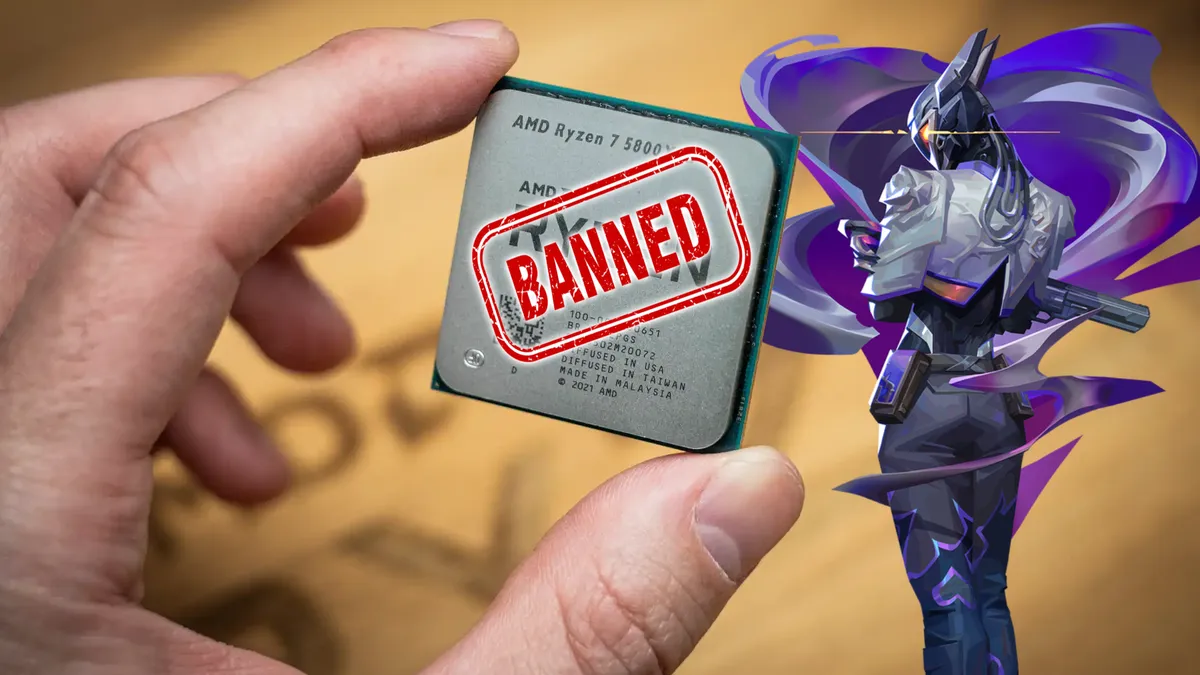
The second-hand market is the most sensible way out when new hardware refuses to drop in price, but it hides a little-known trap: a part that works perfectly can arrive with an inherited ban. That is what happened to a German Valorant player who bought a used Ryzen 7 5800X3D CPU and found his account locked the moment he signed in.
A ban that travels with the part
The case, reported by PCWorld from the buyer’s own account, points to a detail many buyers overlook: modern anti-cheat systems are not satisfied with flagging the account or the IP address alone. They also take a hardware fingerprint, and they can do it component by component. When that fingerprint moves to a new PC, the innocent owner inherits the previous one’s punishment.
In the episode described, Riot support replied that there was nothing to be done to lift the block. And it was not just the CPU: the buyer’s motherboard and storage drive were also flagged in the Vanguard system.
Which components anti-cheat can identify
To read the hardware, the software needs very deep hooks into the operating system and, in some cases, even the BIOS. According to PCWorld, with those kernel-level tools it is technically possible to identify:
- The CPU
- The graphics card
- The motherboard
- The SSD or hard drive
- The network adapter
- The specific operating system licence
- Any combination of the above
On top of that, Vanguard, Valorant’s anti-cheat, only works if the machine has Secure Boot and the TPM module enabled, as Heise.de reports. That is one of the reasons this kind of game is still unavailable on Linux or SteamOS. PCWorld contacted Riot, Valve and Epic Games —the operators of Vanguard, Valve Anti-Cheat and Easy Anti-Cheat— to ask which hardware can be flagged and how to avoid it on the second-hand market. None of them replied before publication, and the track record suggests support rarely lifts a ban applied through a hardware identifier.
What to check before buying second-hand
It is worth keeping this in perspective: it is a very rare problem. To run into it you would have to buy a used part from someone who cheated, who plays the same title —or at least one using the same anti-cheat— and who has already been flagged by that system. That is a very small centre of a Venn diagram; you are still far more likely to get a faulty part or to be the victim of a more conventional scam, such as a denied RTX 3060 warranty over a fake invoice.
Even so, with hardware more expensive than ever and the second-hand market busier than usual, false positives have probably risen. The underlying problem is that there is no way to know whether a component was flagged before you buy it, unless the seller chooses to say so. If the person selling you the part admits to using cheat programs, look elsewhere: the saving is not worth starting out with a locked account.