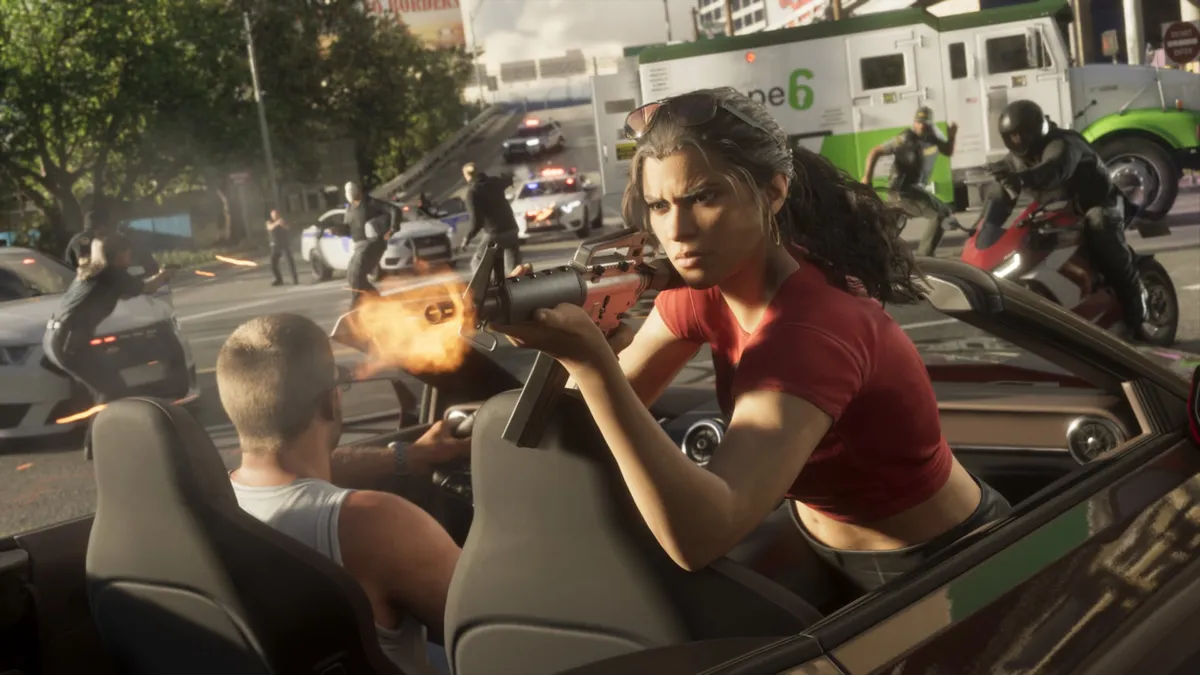
Grand Theft Auto VI runs at 30 frames per second on every console it has shipped on: PS5, PS5 Pro, Xbox Series X and Xbox Series S. And that is where it stays. Rockstar has confirmed there will be no performance mode to raise that figure, not even on Sony’s most ambitious console, and it has also closed the door on the 40 FPS mode for 120 Hz televisions that part of the audience was still expecting.
What Rockstar said, and what it did not
The explanation came from Marc Chambers, the game’s director of technology production, in comments to Kotaku picked up by KitGuru. By his description, the game’s base presentation uses ray-traced reflections and global illumination, and on PS5 Pro that base is extended with ray-traced shadows and more clarity thanks to PlayStation Spectral Super Resolution (PSSR). The console brings an improved graphics processor and upscaling that the studio uses to raise visual fidelity.
The problem appears right after, when the conversation moves from image to simulation: “Even though the PS5 Pro’s central processor is slightly better than the base console’s, it does not have enough power to run the game’s complex simulation at higher frame rates.” In other words, the GPU is not what falls short.
The answer is worth reading precisely. Rockstar talks about simulation and frame rate, and at no point has it announced a patch that would change that limit. What the PS5 Pro adds is image quality, not more frames: the same 30 FPS target, with ray-traced shadows and cleaner upscaling.

The PS5 Pro limit with GTA VI is not in the graphics
The temptation is to think that a performance mode with ray tracing disabled would open the door to 60 FPS. Rockstar’s explanation points elsewhere. When the limit is the CPU, cutting effects frees GPU time the game cannot use, because the processor’s time is already spent: traffic, pedestrians, physics and open-world systems are calculated every frame, regardless of resolution or shadow quality.
That is why the maths does not work out. If the simulation sets the ceiling, a mode with half the effects would still be waiting on the same processor. And the PS5 Pro’s own headroom in that area is small: MuyComputer’s analysis recalls that its CPU improvement is a frequency bump of around 10 % on the same architecture, and that this kind of increase does not translate linearly into frames.
Nor is it the same to talk about a badly optimised game as about a game that asks for more than the generation can deliver. The studio keeps the same 30 FPS target across four consoles with very different hardware, and the price of that decision is giving up the high frame rate on all of them, PS5 Pro included.
What alternatives the player is left with
As of today, the only way to play GTA VI on console is at 30 FPS, with ray tracing enabled and image upscaling doing the rest. The 40 FPS mode for 120 Hz screens is not in the plans for the current generation, according to the studio’s confirmation, so the available range does not move.
Nor should help be expected from the television. Variable refresh rate (VRR) smooths variations within its operating window, but it does not create frames: on many panels that window starts at 48 Hz, above the 30 FPS the game delivers. With a locked target, VRR adds no headroom.
The realistic route for anyone who wants more fluidity is PC, and there the information is still incomplete. Rockstar has confirmed neither a date nor system requirements, and what circulates about the possible PC release in 2027 comes from unconfirmed reports. There is no announcement of a version for the next console generation either: any expectation in that direction is projection, not a commitment from the studio.
The decision
If frame rate is the main criterion for choosing a platform, GTA VI will not satisfy it on console, and there is no patch in sight that would change that. What does deserve attention is stability: 30 FPS with a regular frame pacing is easy to live with; one that fluctuates is not. That is the metric to watch in technical analyses, more than the round number.
For everyone else, the decision remains the usual one: you buy a console for its catalogue and for the support it will receive over the generation, not for the spec sheet. In this case, moreover, the sheet already says from today that the current generation stays at 30.