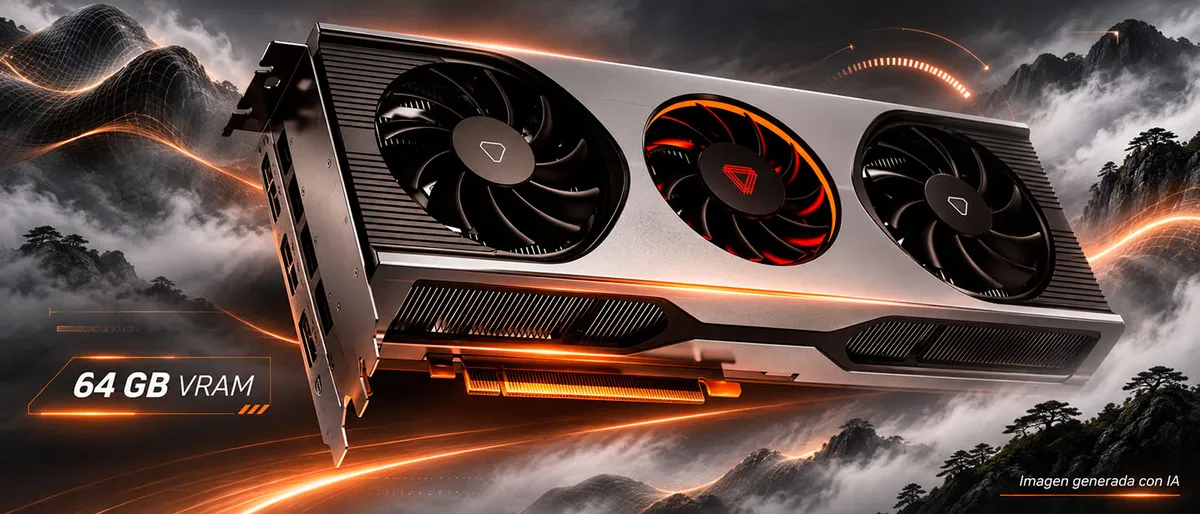
Moore Threads has shared new details about the Lushan GPU, its next consumer graphics card, and the figure that has dominated the conversation is memory capacity: up to 64 GB of VRAM, according to statements the company has made over the past few months. If confirmed, it would double the 32 GB of GDDR7 on the GeForce RTX 5090, which currently sets the memory ceiling in the consumer segment.
It is worth separating from the outset what is an announcement, what is a leak and what remains unconfirmed. The announcement is the existence of the Lushan and its presentation scheduled for 29 December at the MUSA Developer Conference (MDC 2026), in Beijing. The leak is the specifications that AIR_FORCE, product manager for the MTT S80, has detailed through the Chinese social network Bilibili. And what is not confirmed is the exact memory figure: the company itself has not settled it, and the estimates start from an earlier promise, not from a published spec sheet.
What is known and what remains to be confirmed about the Lushan
The 64 GB figure does not appear in an official specification; it is inferred from a prior commitment. During the presentation of its Huagang architecture, in December 2025, Moore Threads stated that the new generation would quadruple graphics memory capacity compared with the previous one. The MTT S80, its current card, carries 16 GB of GDDR6; applying that factor of four gives 64 GB.
In other words, a calculation consistent with what was promised, but not a confirmation. There are also no data yet on memory speed, bandwidth, TGP, price or availability outside China, and none of those variables allows for anticipating real-world performance. The 29 December presentation should settle the capacity question, though not necessarily the rest.
VRAM for local AI, not just gaming
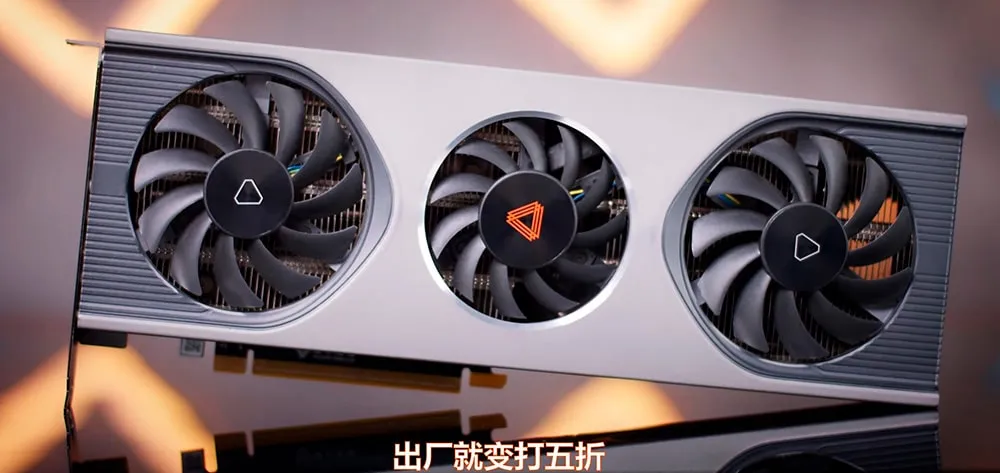
Moore Threads’ reading is not purely gaming. The company has tied the Lushan to the growing interest in running artificial intelligence models locally, where a large VRAM reserve allows loading larger language models without depending as much on system RAM. With that approach, the card would position itself as a hybrid option for those who alternate between gaming, content creation and AI workloads on the same machine.
The price context helps explain the interest. According to the original outlet, the GeForce RTX 5090 already exceeds 10,000 euros on the market, an escalation that fits with the RTX 50 price increase in November, which added as much as 500 dollars to the RTX 5090, and with NVIDIA’s acknowledgement that supply is tight. A GPU with twice the VRAM does not compete on frames; it competes on capacity per euro, and there Moore Threads’ margin is wider than its track record suggests.
Promised performance and the fine print
Moore Threads has also put numbers on the table for the Huagang architecture, and all of them are from the manufacturer, not independent measurements: up to 15 times more performance in AAA games, 50 times more in ray tracing, 64 times more in AI compute, 16 times more in geometric processing, four times more in textures and eight times more in atomic memory operations.
On paper, the Lushan would add support for DirectX 12 Ultimate, a second-generation ray tracing engine and the UniTE rendering technology, which combines traditional rendering with AI-assisted processing. These are relevant improvements because the brand’s previous cards, such as the MTT S80, carried serious performance and compatibility limitations against NVIDIA, AMD and Intel.
The fine print remains the usual one with this kind of promise: a multiplier with no reference resolution, game or settings says nothing about performance per watt or about price per frame. And in the area where the Lushan wants to stand out, VRAM, the bottleneck may lie elsewhere: bandwidth, compute power and, above all, software maturity. Without tested drivers and without a price in euros, an honest comparison with an RTX 5090 still cannot be closed; what is clear is that doubling memory is an advantage no other consumer card offers today.