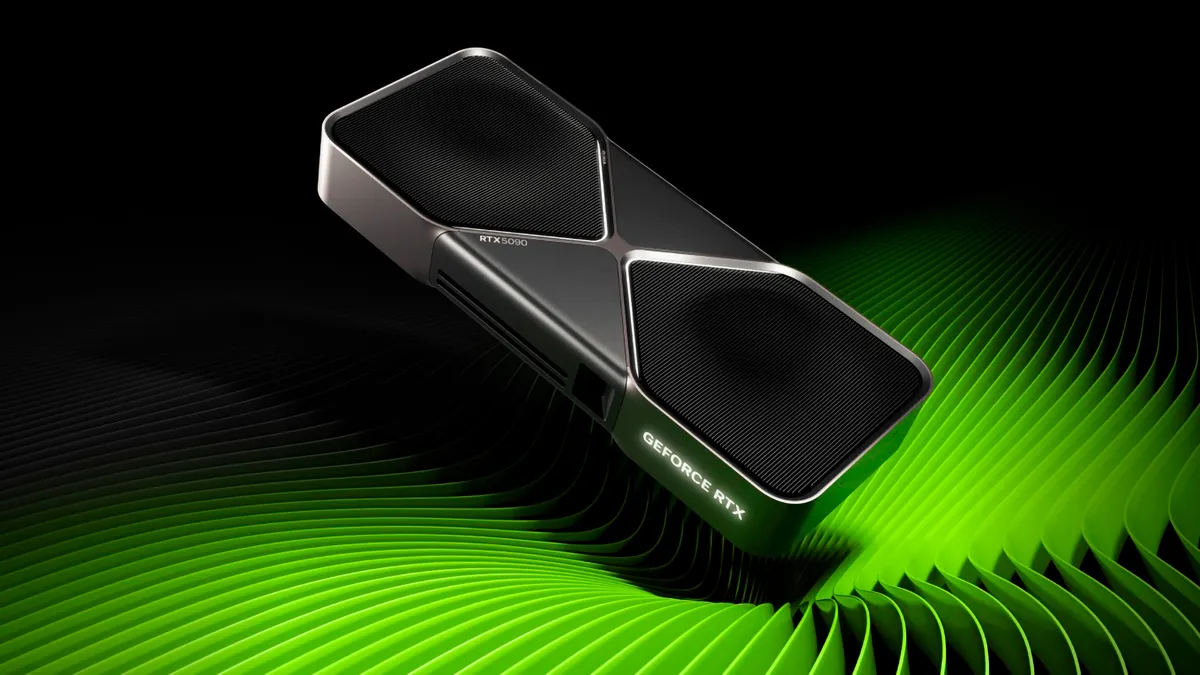
Buying a GeForce RTX 5090 at a physical store in the United States is no longer a routine errand. A Micro Center customer in Tustin, California had to sign a form titled Advanced Computing Product Purchaser Declaration before the store approved the sale of the card, according to the buyer’s own account posted on the r/Microcenter subreddit. The document makes the transaction conditional on declaring one’s identity, the physical destination of the product and its intended use, and adds an explicit no-export clause.
The buyer purchased a PowerSpec AI90 Workstation with an AMD Ryzen 9 9950X processor, an RTX 5090 Founders Edition, 64 GB of DDR5-6000 memory and a 2 TB SSD. The surprise came when the store manager demanded the declaration before closing the purchase. The RTX 5090 is the most in-demand consumer GPU right now, and in the US it already suffers from availability problems and markups, as we covered when we looked at the card’s disappearance from online retail and its resale prices.
What the form requires
Micro Center’s declaration is not a generic consent. The form asks for:
- Full legal name.
- Residential or business address.
- Government-issued photo ID.
- Phone and email.
- Actual end user, if different from the purchaser.
- Location where the product will be installed.
- Intended end use.
On top of that comes the clause that gives the episode its name: the document warns in capital letters that no export is allowed and that Micro Center will not sell the product to anyone who intends to export, re-export, resell, transfer or otherwise cause it to leave the United States, “regardless of destination.” The store has not explained why it started asking for the form, and several users in the thread point out that they were not required to do so on previous purchases.
Why Micro Center asks for the form to sell an RTX 5090
The context is export control. GPUs with processing power equivalent to an RTX 4090 or higher became subject to restrictions on sales to China in November 2023. However, US authorities have only stepped up their pursuit of smuggling recently. The most talked-about case is that of three Supermicro employees, including co-founder Yih-Shyan “Wally” Liaw, suspected of illegally shipping $2.5 billion worth of Nvidia hardware to China. Add to that anecdotal accounts of buyers acquiring used RTX 5090s in large quantities, with testing rigs mounted in their own cars and cash payments.
In this scenario, the form works as an administrative barrier: it forces the buyer to identify themselves and commit in writing, although it provides no technical guarantee that the card will not end up resold outside the country.
What changes for the buyer
The document’s real effectiveness is debatable. Since the form does not record the serial number of the GPU sold, it cannot track a specific unit if it later shows up in another market. Its most plausible effect is as a deterrent: it makes the process more expensive for anyone buying high-end hardware intending to resell it at a higher price, whether on the local market or abroad.
For the buyer who just wants an RTX 5090 for their own system, the change is one more layer of friction on a product that is already hard to find at its reference price. And this is not an isolated case at Micro Center: in the same thread, another user says they had to fill out a similar, though longer, form when buying a GPU at Central Computers last summer. The open question is whether these declarations will become widespread among retailers or remain one-off initiatives while the debate over GPU smuggling stays open.