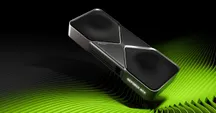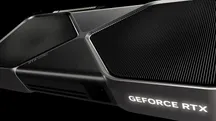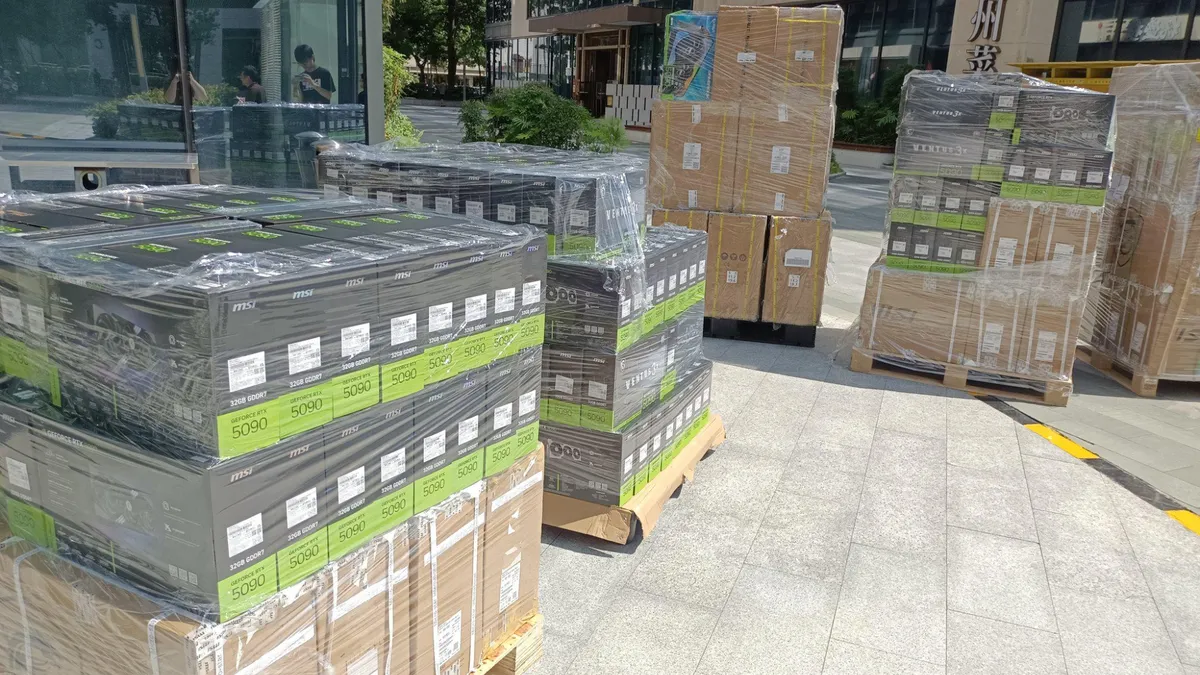
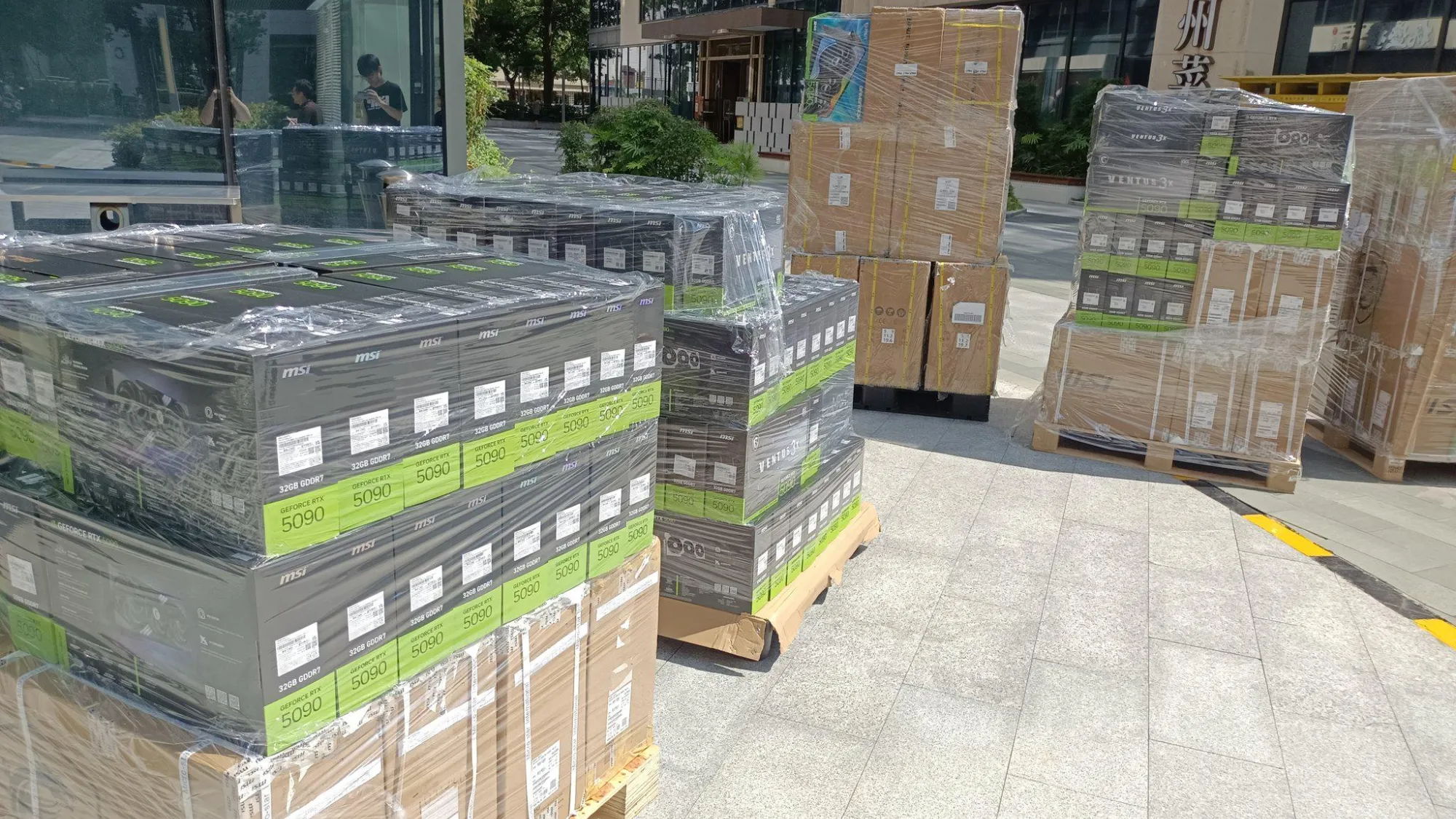
Two pallets of RTX 5090 valued at around $470,000 —2.5 million Brazilian reais— did not appear after arriving at Guarulhos International Airport in São Paulo. The Brazilian electronics and IT distributor Oderço, with 38 years of activity, published its claim on Instagram after failing to get an official response to its inquiries, and Tom’s Hardware is covering the case.
What Oderço Says and What It Doesn’t
According to its post, Oderço expected to receive two pallets of Zotac RTX 5090 GPUs at Guarulhos. The shipment arrived at the airport and, according to the company, disappeared afterward. The distributor claims it is the first time in its 38-year history that it has faced a situation like this.
The data provided by Oderço itself is sparse: it does not indicate the arrival date of the shipment nor publish tracking numbers. What it does assert is the other side of the coin —that it has received no official response to any of its inquiries about the cargo— and that absence of explanations is what led it to go to social media to demand answers. The post is in Portuguese; Tom’s Hardware translates it automatically.
How Many RTX 5090s Fit in Two Pallets
The figures handled by the distributor are the only ones available, and they need to be distinguished. The 2.5 million reais cited by Oderço correspond to its acquisition cost, not the retail selling price, so the resale value of that lot would be considerably higher.
To size it up, Tom’s Hardware takes as a reference the Zotac RTX 5090 Solid OC, listed for 33,999.99 reais at Brazilian retailer Promotech, and a Zotac Gaming GeForce RTX 5090 that rounds to around $8,000 on Amazon (U.S.). With those figures, the outlet calculates the shipment at at least 63 cards and warns that the real figure is probably higher: the 2.5 million reais is the price Oderço paid for the cargo, not what it would get selling them.
The company itself has not specified how many units are missing, so that count remains a Tom’s Hardware estimate, not a confirmed figure from the shipper.
Why Such a Loss Weighs More on the Current RTX 5090
An RTX 5090 is not today an ordinary purchase. The card vanished from U.S. online commerce in mid-September and resellers went as high as $9,500 per unit, an episode we already covered when analyzing the disappearance of the RTX 5090 from U.S. online retail. On top of that scarcity mounted the rumor that NVIDIA had halted production to dedicate capacity to AI professional cards: the company has denied it and admits that supply is tight, while the reference remains marked as «not carried» in Micro Center’s online catalog.
In that context, the fate of these two pallets is not a logistics detail. Those units were destined for a market where supply no longer covers demand, and their disappearance removes stock from the chain rather than adding to it.
The theft of high-value hardware shipments is also nothing new: in California a group rammed security escorts to kidnap an AI hardware shipment, and in another case they took two trailers with the NVIDIA logo only to discover they were loaded with sand. At the scale of an individual, the different but neighboring front is that of scams involving the card itself, such as the secondhand RTX 5090 that arrived without GPU or PCB.
What Changes for the Buyer
For anyone looking for an RTX 5090, the episode does not alter the background picture: the card remains hard to find and more expensive than its catalog price suggests. What it does make clear is that in such a tight supply, the disappearance of a full shipment is not an administrative error: it removes units from a market that already doesn’t have enough of them.
While Oderço does not receive explanations, the case remains open with no official figure of lost units. And while scarcity persists, the practical question for the buyer remains the same: absorb NVIDIA’s premium or evaluate the high-end alternative with better price per frame.