With its teardown of the Apple Watch Series 12 and the Apple Watch Ultra 4, iFixit closes out its round of analyses for Apple’s September launches. The verdict is as clear as it is uncomfortable: there are improvements, but none of them touches the underlying problem. If your screen ever cracks, the watch remains a headache to repair.
The teardown, led by Shahram Mokhtari, leaves two scores that confirm that impression. The Series 12 lands at 4/10 on iFixit’s repairability scale, one point higher than the last base-model Apple Watch the firm had scored. The Ultra 4 repeats the 4/10 of its predecessor, the Ultra 3, with no change.
What actually improves on the Series 12
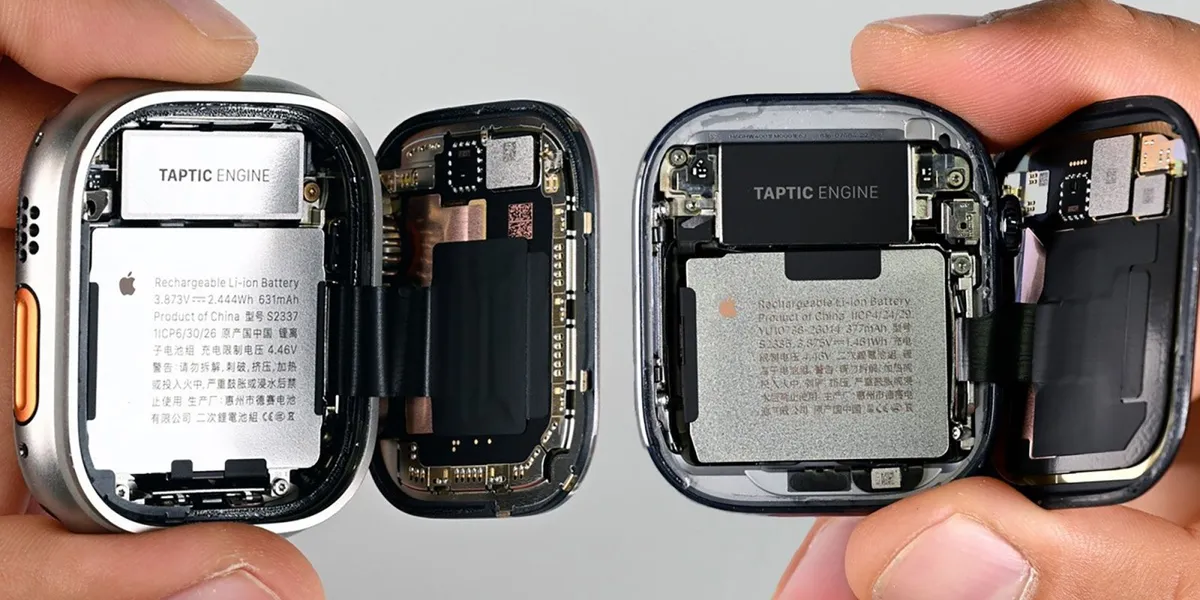
The good news is where it is felt most in daily use: the battery. Apple added stretch-release adhesive and a pull tab that make the 1.461 Wh cell in the Series 12 far easier to remove, up from the 1.403 Wh in the 46 mm Series 11. It is the kind of change that, in practice, separates an affordable battery swap from one that turns into a trap.
The connector change points the same way. Apple replaced the ZIF connector and tape used on earlier models with a simpler press connector. That is where the tradeoff shows up: the new system means replacing the screen now also requires removing and refitting the battery — something that, for anyone who has already made it that far, is no real added burden.
On the Ultra 4, by contrast, the battery grows from 2.313 Wh to 2.444 Wh, but replacing it still requires taking off the screen first. The four screws on the bottom of the case only give access to the sensor assembly on the underside of the back cover and to the S11 chip housed in the case itself.
The glued display: the obstacle that does not move
The pattern repeats on both watches: getting inside means prying the screen off with heat. On the Series 12, Mokhtari warns that the tolerances around the panel are even tighter than on the Ultra 4, to the point that it took enough force to make him fear for the screen’s integrity.
Once it is off, removing the battery and disconnecting the display’s press connector is straightforward, provided the first step was done carefully enough to avoid slicing the flex cables underneath. The problem is not what comes after, but the way in.
What changes for anyone buying a watch
The benchmark iFixit sets puts the bar where it belongs. It gave Google’s Pixel Watch 5 a 9/10: its display comes off with just two Torx screws and a gasket, and its battery can be removed without wrestling with adhesive. The gap between a 9 and a 4 is felt every time the watch has to be opened.
For the reader, the practical reading is the same one that iFixit’s AirPods 5 teardown already left behind: battery life and new features matter day to day, but repairability is worth checking before you decide. If you want a watch you can keep for years, here the Series 12 and the Ultra 4 still depend on official service for almost any screen failure. If what matters to you is battery life and the Apple ecosystem, the battery improvements are a real step — just a small one.