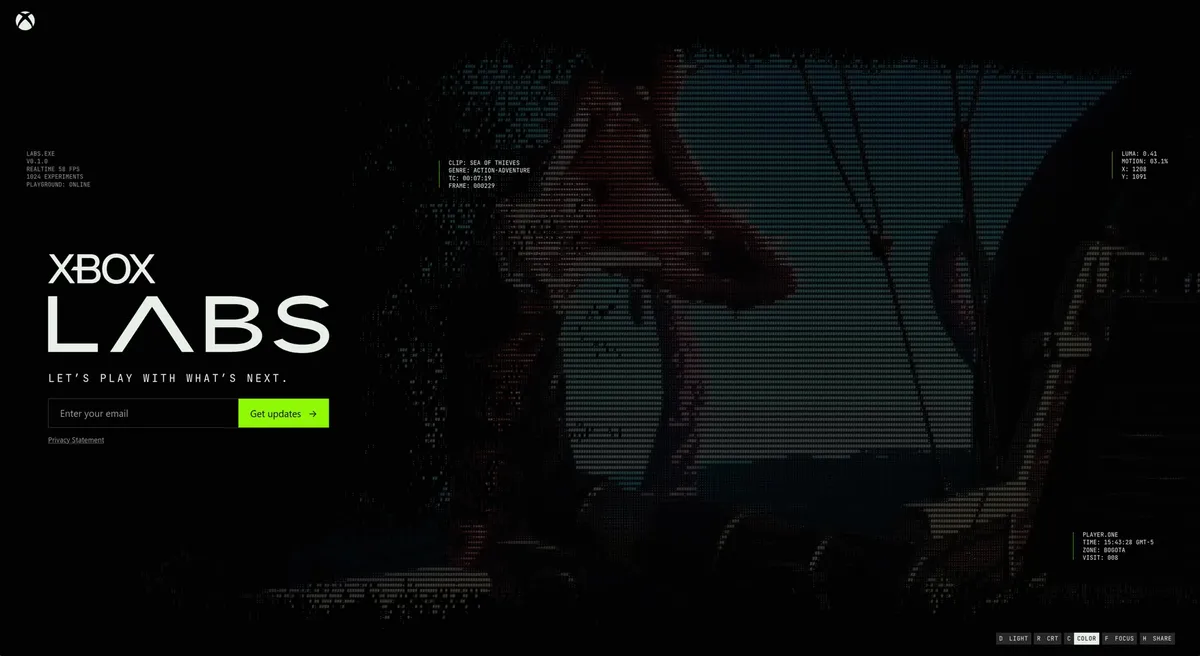
Microsoft has formalized Xbox Labs, a small team of creators, engineers, and scientists whose mandate is to turn emerging ideas into something players and developers can test. The company presents it as a bet on retrocompatibility, FPS Boost, compatibility layers, and AI experiments, and the announcement reads like its response to the phenomenon of unofficial mods and ports that AI has put on the table in recent weeks.

Xbox Labs: A Small Team Working in Plain Sight
The announcement came via an internal memo that Xbox CEO Asha Sharma sent to staff and was subsequently made public. In it, she explains that she asked Scott — without a last name in the communication — to launch Xbox Labs, and sets out how they will work: build in plain sight, learn from what people do, and measure success by whether more people play and create.
The memo insists that the team is independent of Xbox Game Studios’ main projects, at least for now, and that the company’s priorities don’t change: games, hardware, and intellectual property management stay where they were. For the player, the useful reading is another: Microsoft reserves space for experimentation without touching the already-running release calendar.
Why it matters: AI has moved the board
Xbox Labs does not emerge from a vacuum. In the weeks prior to the announcement, the community has decompiled and recompiled games to run on hardware they were never designed for, translated PC versions to Apple Silicon and brought them to the browser via WebAssembly and WebGPU — a foundation that already touches 90% of global support — and even reached inserting entire games into another’s source code. The most talked-about case was an experimental port that carried PS5 games to the Xbox Series X, exactly the type of project the new division seems to want to organize.
Sharma acknowledges in the memo that these experiments question assumptions taken for granted, such as the link between software and hardware or the boundary between creating and playing. She also points out the argument of scale: on Xbox, more than 72 billion hours are played per year, about five times the estimated time spent writing code worldwide, and AI agents have already demonstrated they can write, run, and test software. Hence the idea that games are a natural terrain for these tools.
What changes for the player
For now, little and slowly. Xbox Labs is a statement of intent, not a product: there are no confirmed dates or features, and the announcement itself avoids promising results. The fine print matters too, because the company commits to sharing with the industry the tools it builds, and to maintaining respect for intellectual property and for the communities that already exist around its franchises.
The promise that truly interests gamers is bringing new life to old games and making access to major titles easier, exactly the terrain where retrocompatibility and compatibility layers make the difference. If that work bears fruit, the advantage won’t be measured in teraflops, but in how much longer a generation’s catalog holds up. We’ll have to see if Xbox Labs turns it into something playable.