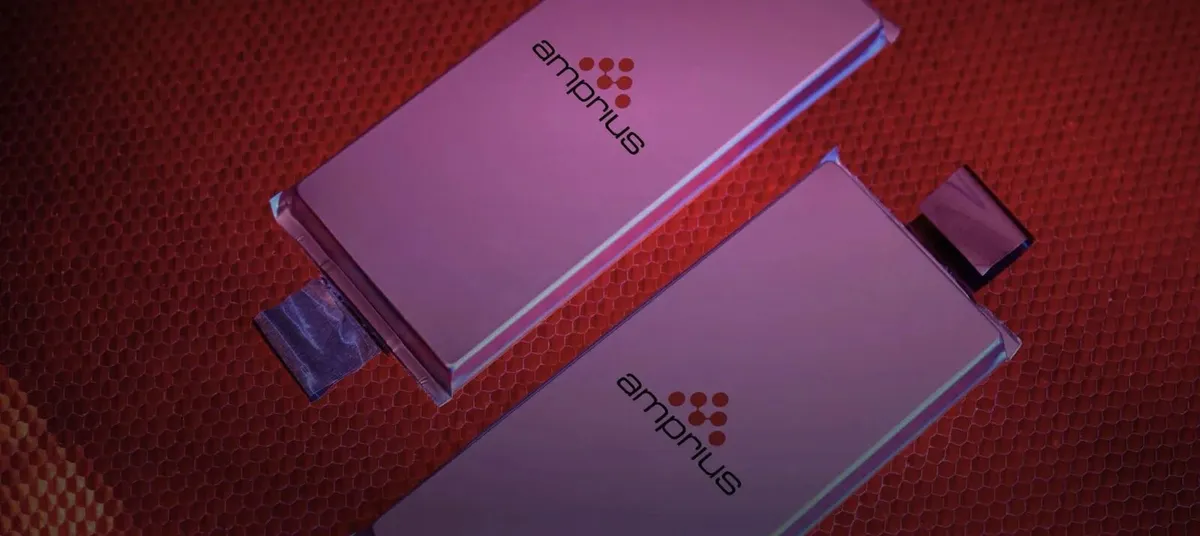
Amprius Technologies will convert an electric vehicle battery line in the United States into a drone cell factory. The California company announced on September 28 that the facility, run by an unnamed South Korean manufacturer, is meant to reach 12 million silicon-anode cells a year for Group 1 through 3 drones, with production slated to start in early 2028. The public backing is a grant of up to $75 million from the Department of Defense that, by the company’s own account, is mostly unfunded.
A retrofit rather than a new factory
The plan avoids building a plant from scratch. The conversion costs around $100 million, with Amprius and its partner covering the rest in kind. The line will add pouch cells, a format that joins the cylindrical cells Nanotech Energy already makes in Northern California. Amprius has been producing cells through a South Korean partner since September 2025.
Chief executive Tom Stepien pitched the project on CNBC as the opposite of his previous industrial bet: “We’re not pouring concrete, we’re not putting steel up,” he said. The choice to retrofit is no accident. In March 2023 Amprius had announced $190 million to turn a 774,155-square-foot building in Brighton, Colorado, into a battery factory, with a $50 million grant from the Department of Energy. It cancelled the plant in June 2025 and this year paid $20 million to end the Brighton lease.
Stepien put a number on the business: the 12 million cells represent about $150 million in incremental annual revenue. In August, Amprius raised its full 2026 revenue guidance to at least $140 million. One converted line, fully funded and fully sold, would more than double the company.
A $75 million grant with $22 million committed
The gap between the headline and the cash is the weak point of the announcement. Amprius acknowledges that a majority of the grant remains unfunded and subject to future appropriations. Payments also depend on the government accepting specific milestones, which the company says it may not hit on time or at all. The money comes through the Industrial Base Analysis and Sustainment program.
The deal is a fixed-price Other Transaction Agreement called Project acCELLerate, signed on September 23 according to the company’s 8-K filing. So far the government has obligated about $22 million, drawn from fiscal 2025 research and development funds, for a base period that runs to September 22, 2028. That is less than a third of the announced figure.
Why batteries are the bottleneck
The Pentagon’s interest is not abstract. In October 2024, Beijing ordered Dongguan Poweramp, Skydio’s sole battery supplier, to cut the company off, and the largest US drone maker had to ration packs. A former senior defense official ranked batteries among the top three Chinese parts in Blue UAS aircraft.
Regulation pushes the same way. Prepared Senate testimony under the Drone Dominance Program said Phase II would ban systems using batteries or motors from covered countries, and Phase 3 of the program, worth $450 million and focused on attack drones, has just opened. Stepien said about half of the 19 drone makers invited to the Fort Carson demonstration use Amprius cells. A separate Defense Innovation Unit contract for NDAA-compliant drone batteries now totals $18.1 million.
On performance, Stepien said on air that his cells are twice as energy dense as anything else; the announcement is more cautious and cites up to twice the energy density of conventional graphite-anode cells. The executive himself acknowledged that China still makes cheaper cells that many customers want, and that he expects a balance between buyers chasing the best price and contract-bound buyers that must build outside certain countries. His deadline challenge: the anode, cathode, separator and electrolyte all have to come from outside a foreign entity of concern in about 15 months.
Money is the fragile part of the operation: a mostly unfunded grant depends on Congress, and the early-2028 date only holds if those appropriations arrive. The domestic line closes the supply gap; not necessarily the price gap.