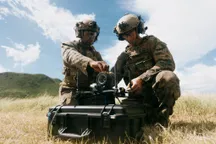
The Pentagon opened Phase 3 of its Drone Dominance Program on Monday, September 28, with $450 million on the table for roughly 60,000 attack drones and an option to buy up to 40,000 more. There are two separate mission sets —Deep Strike, with stand-off ranges out to about 20 kilometers, and Close Quarter Battle, for close-in combat— and one condition that allows no shortcuts: every company that wants to reach Gauntlet III must first deliver a production order of 400 drones in about two months.
Phase 3 of Drone Dominance: two missions, 60,000 drones and a 400-unit gate
The announcement splits the program into two missions. Deep Strike covers stand-off attack out to about 20 kilometers (12 miles), and Close Quarter Battle takes the close-in fight. The committed figure is around 60,000 aircraft, with an open option for another 40,000 at prices set by the manufacturers themselves, leaving a ceiling of 100,000 units.
The entry gate to the third round is demanding. In Gauntlet II, participants had to complete an order of 120 drones with lethal payloads in about five weeks to qualify. In Gauntlet III the volume more than triples —400 units— and the deadline stays at about two months. Gauntlet III is capped at 14 companies.
The listed prices do not cover the $450 million
The contradiction is in the arithmetic. The announcement sets Deep Strike at $5,000 per unit, excluding weaponization, and Close Quarter Battle at $3,000. At those prices, 60,000 drones cost at most $300 million (if they were all Deep Strike) and at least $180 million (if they were all Close Quarter Battle); an even split would come to $240 million. The program puts up $450 million and does not explain what covers the difference.
The wording allows a second reading: it splits the money evenly across the two mission sets without saying whether it means dollars or drones. If the split were by dollars, $225 million would buy 45,000 Deep Strike drones at $5,000 and 75,000 Close Quarter Battle drones at $3,000 —that is, 120,000 in all, twice the announced number.
Rising prices and an option the market will price
Part of the gap may lie in the payloads. The Gauntlet II companies were each paired with one or more lethality providers, and Swarm Defense, fifth in Deep Strike, received a prototype order valued at a minimum of $25 million for 4,000 Kiwi drones plus munitions and control software, about $6,250 per aircraft at the contract floor. Even applying that rate to all 60,000 drones, the bill comes to $375 million, $75 million below the $450 million.
Prices have moved too. Deep Strike rises to $5,000 from $4,500, excluding weaponization, to pay for better compute, communications and sensing; Close Quarter Battle falls to $3,000 from $3,500. The option for 40,000 extra drones will be settled at prices set by the manufacturers, and the program says it exists to buy more aircraft and “better understand the pricing in the marketplace.”
The December 2025 plan was different. According to Washington Technology, the request for information laid out Phase 3 as 100,000 drones at $3,000 each and Phase 4 as 150,000 at $2,300, with payment only for delivered drones. That was before Gauntlet I bought about 30,000 drones for up to $150 million. Of those figures, the 100,000 ceiling survives —60,000 committed and 40,000 open to offers— along with the $3,000 price, which now holds for Close Quarter Battle alone.
Ten awardees, a cap of 14 and the Skycutter case
There is fine print in the company allocation as well. The announcement counts ten Gauntlet II awardees, which skip the pitch steps and go straight to Gauntlet III in the mission they won. Neros —one of the Gauntlet II awardees, whose order we have already covered— appears on both lists, so the two boards name nine distinct companies. Everyone else submits a proposal on NSTXL and about eight companies get a November Pitch & Fly. The announcement does not clarify whether the cap of 14 counts companies or awards: depending on how it is read, four or five of those eight fit.
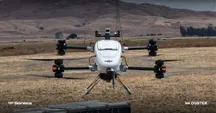
One specific case shows why the 400-drone gate weighs more than a leaderboard score. Skycutter finished fourth in Deep Strike, but the program’s status page listed it in July as neither ramping nor shipping its Gauntlet I order, according to Aviation Tech Today. To reach Gauntlet III it will have to deliver those 400 drones.
What does Phase 3 leave behind? For now, a date and a number. The date is November’s Pitch & Fly; the real test is who can build and ship. As DroneXL sums it up, a score says a drone flew well at Fort Carson in August, but 400 delivered drones say a company knows how to build them. You can follow the rest of the section in our drone coverage.