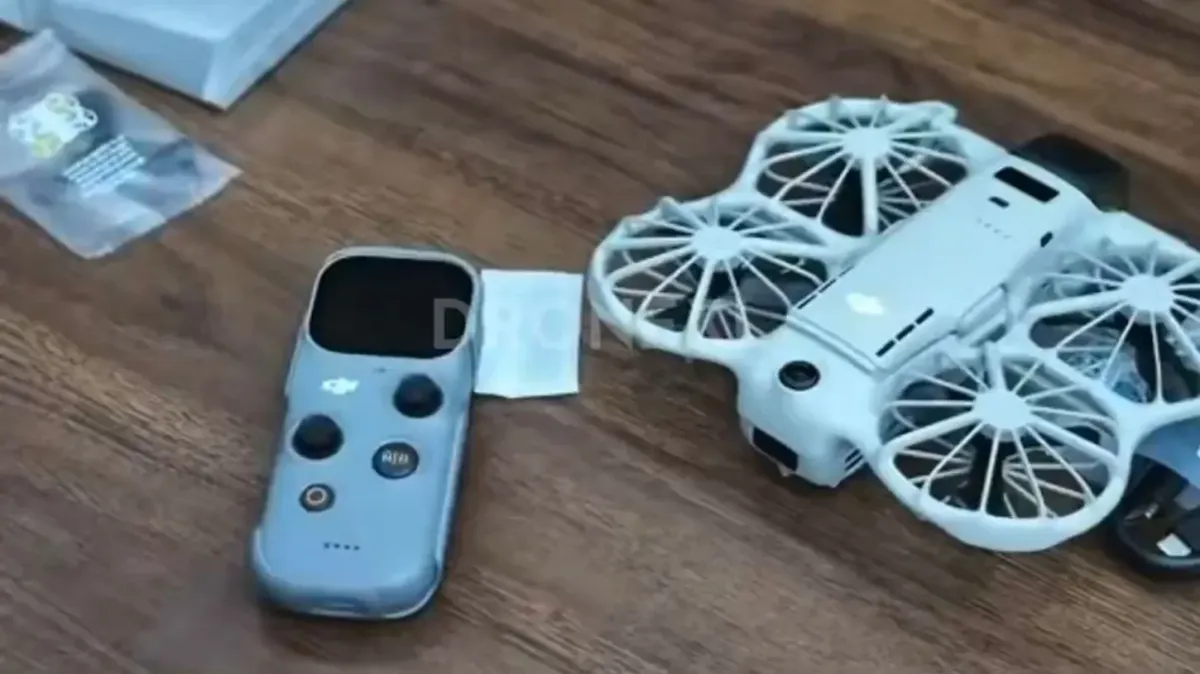
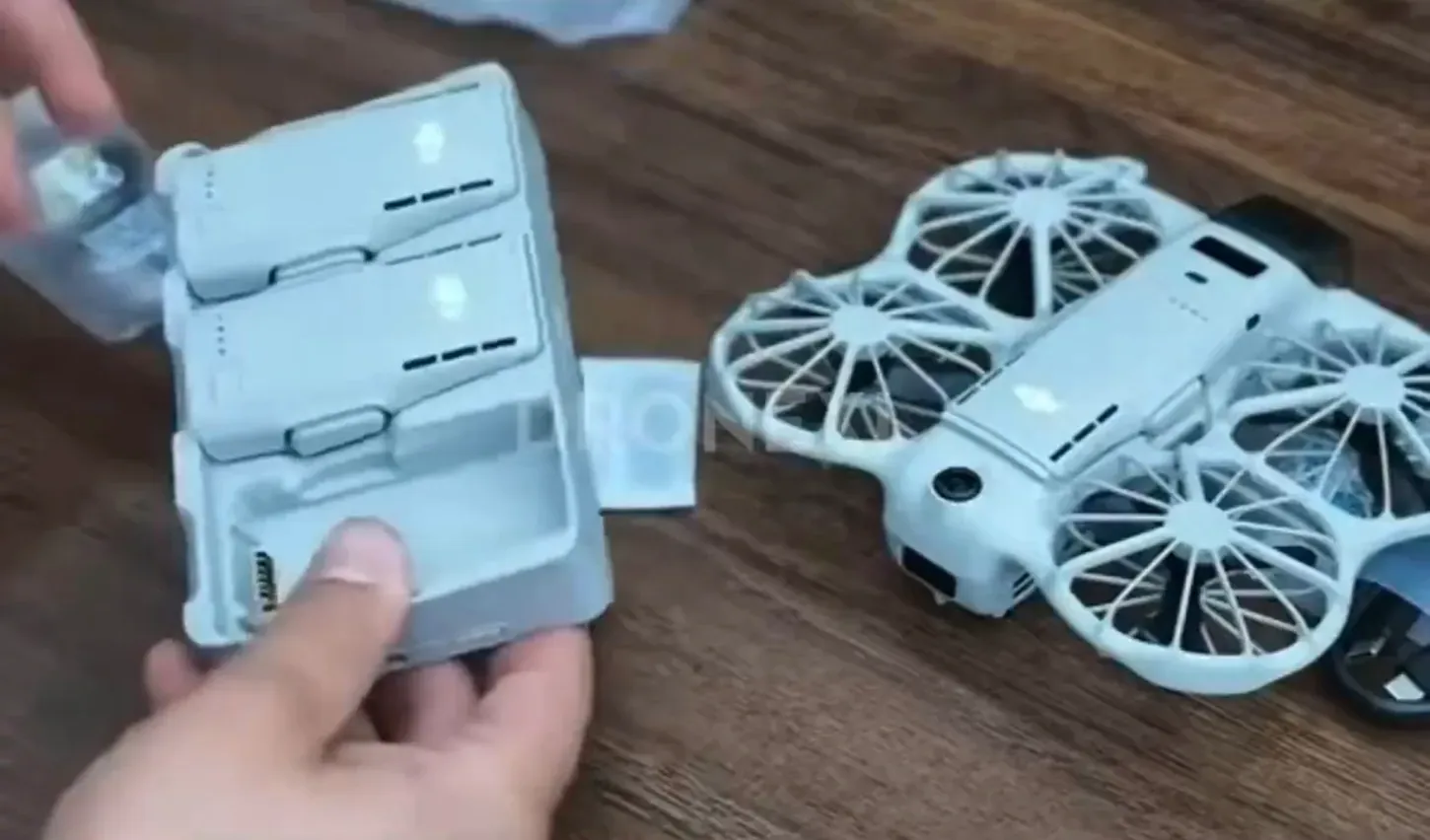
A 49-second unboxing video of the DJI Neo 3 Fly More Combo reached X on Tuesday, and this time the drone itself comes out of the box. The clip, shared by DroneXL contributor Jasper Ellens, shows the aircraft next to the DJI RC Mini controller with a screen, a charging hub, a USB-C cable and two sealed bags. Both the video and the images are a leak: DJI has not announced the Neo 3 and there is no official confirmation of its specifications.
The video comes from a leaked TikTok post of which a friend of Ellens kept a copy, according to DroneXL. The original leak post should be read with the usual caution: the details below come from the clip and from earlier leaks, not from DJI’s own documentation.
What the DJI Neo 3 video shows
The drone appears with spoked cages over all four propellers, a design that protects the blades from the knocks a beginner pilot will give them and makes indoor flights easier. The rest of the kit matches the retail box panel that leaked in September: the aircraft, three flight batteries, the charging hub, the DJI RC Mini controller and a USB-C cable. The panel also lists spare propellers and a screwdriver, though the clip never shows what is inside the sealed bags.
The hub holds two batteries and a third sits in the drone. Each battery shows rows of black slots on its top face, plus four status LEDs and a button to check the charge level on the battery itself. One of the final shots shows a battery being inserted and a regulatory label in the bay underneath.
The slots and the weight: what the leak corrects
The slots are the detail that changes the most against what was believed. On September 21, Ellens argued that slots like these made him think a circulating Neo 3 image was AI-generated, and DroneXL wrote that a flight battery with slots was not something DJI shipped from the factory. With the video on the table, the conclusion flips: the slots are real, and the September 21 image was the drone printed on the retail box, so the box drew them because they are on the battery.
The video cannot show whether those slots move air or are only a styling finish. The spec sheet that leaked on October 1 gives no battery figure or flight time either, so the real endurance is still unknown.
There is room for nuance on weight too. Ellens puts the drone at almost 200 grams, a figure that includes the transceiver now built into the airframe, according to DroneXL. The exact number comes from a production listing Igor Bogdanov posted last month: 192.7 grams. The DJI Neo 2 weighs 151 grams on its own and 160 grams with the screw-on transceiver, so, compared like for like, the jump would be around 33 grams.
What it means for a potential buyer
The Neo 3 keeps the Neo line formula —a beginner drone, palm launch and simple flight— and adds a kit that covers a full first afternoon: the cages take the hits and the three batteries stop the session from ending when the first one runs flat. The RC Mini controller, however, reads as a step backwards if you already fly with a DJI RC 2 with a built-in screen. Other DJI proposals have already been through our pages, such as the DJI Avata 360 tested across five FPV jobs.
The essentials are still missing before drawing conclusions: the aircraft has no FCC grant in the United States, while the RC Mini got one on December 19, 2025, so without authorisation DJI could not sell it there. And the small rectangular screen on the nose, just behind the gimbal, which glows blue in one shot, never appears showing anything readable in the whole video: no official source explains what it displays. The obstacle-avoidance sensors, with a round lens facing up at the rear and dark windows on the arms, point to omnidirectional detection, but it bears repeating: none of this is confirmed by DJI.