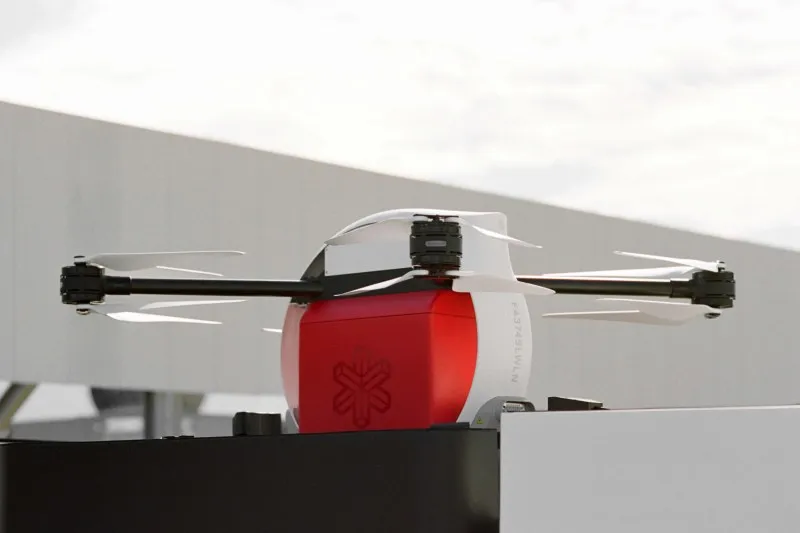
Matternet has unveiled the M3, the next generation of its autonomous drone delivery platform. The Mountain View, California-based manufacturer targets commercial service in the second half of 2027 and has already named its first two launch partners: restaurant chain Dave’s Hot Chicken in the United States and UK-based Apian, which runs a drone healthcare network for the NHS in central London. The company expects to announce more partnerships in the coming months, aimed at high-volume deliveries.
The announcement lands just days after its shares began trading. Since September 21, Matternet has been listed on the OTCQB Venture Market under the ticker symbol MTTN, following a $33 million reverse merger completed in June. The company presents itself as the first publicly traded pure-play drone delivery company.
What the Matternet M3 is
The M3 is not a standalone drone but a complete system designed so a restaurant, store or hospital can install a delivery point without on-site flight crews. It consists of three hardware pieces:
- M3 aircraft. An autonomous drone able to carry payloads of up to 11 pounds (5 kg) within a 10-mile (16 km) service radius. Its cargo bay accepts standard merchant packaging, such as food bags and retail boxes, plus dedicated configurations for healthcare and industrial payloads.
- M3 dock. A station that stores and charges the aircraft between flights. It can be installed on a rooftop or at ground level.
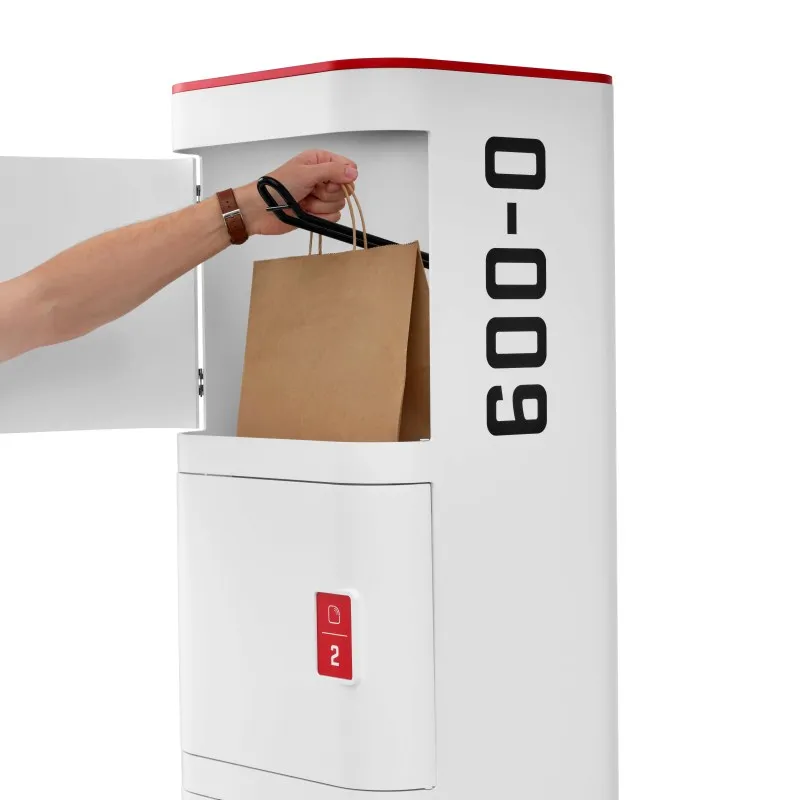
- M3 portal. A low-cost, off-grid drop box where the sender deposits several packages at once for later pickup.
The workflow is the part Matternet emphasizes: the employee places the package in the portal and walks away. Everything else — takeoff, route, delivery and return — happens with no operator on site, no ground handlers and no one interacting with the aircraft.
More payload, less range than the M2
Against the M2, the M3 lifts 2.5 times the payload capacity: 11 pounds (5 kg) versus the previous model’s 4.4 pounds (2 kg). The trade-off is range. The M3’s 10-mile (16 km) service radius sits below the M2’s roughly 12.4 miles (20 km). The operational read is clear: more weight per trip and somewhat shorter coverage, which in a dense urban setting does not necessarily mean fewer useful deliveries.
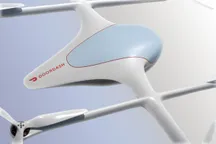
The move fits an architecture shift spreading across the sector. Operators are abandoning the hub-and-spoke model — which requires a courier to carry each order from the kitchen to a launch site — and racing to place micro-docks directly on merchant rooftops. Days earlier, competitor Flytrex unveiled unpowered Rooftop Docks with an 8.8-pound payload. Matternet differentiates itself on weight and on the flexibility of the portal’s asynchronous workflow. DoorDash Air is moving in the same direction with its own platform.
The company is also backing the rollout with its strategic partnership with SoftBank Robotics America and with plans to build M3 aircraft manufacturing capacity in the United States. According to founder and CEO Andreas Raptopoulos, the goal is for drone delivery to work like a basic utility: “largely invisible, dependable and low-cost,” in his words.

No FAA certificate yet
Here is the nuance that separates the product from the calendar. The M2 was the first drone delivery system to obtain standard Type Certification and Production Certification from the U.S. Federal Aviation Administration (FAA), in September 2022. The M3, by contrast, still has no type certificate: a Federal Register search turns up airworthiness criteria for the M2 only. Matternet’s own release lists M3 certification among the factors that could shift the launch date.
History offers a reference point. Between the publication of the proposed airworthiness criteria for the M2, in November 2020, and its certificate, 22 months passed. For the M3 there are no published criteria, and customer testing is still ahead. The announcement also included no order figures, aircraft count or price. In that context, the second half of 2027 works as a roadmap rather than a commitment. Drone delivery is still waiting for its definitive framework, as shown by the lawsuit filed by fifteen states against the FAA over the environmental clearance for these operations.
With those figures on the table, the M3 is a coherent proposal for the sector’s real bottleneck — cost per delivery and labor at the origin point — but its date depends on a certificate that has not yet begun to be processed.