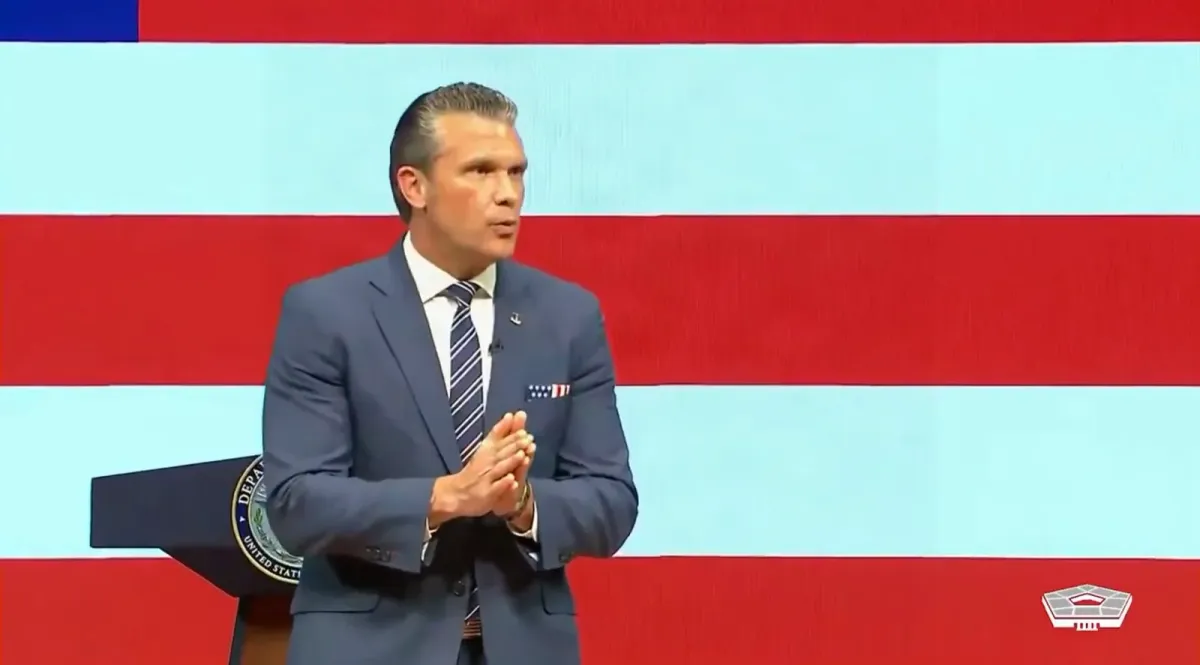
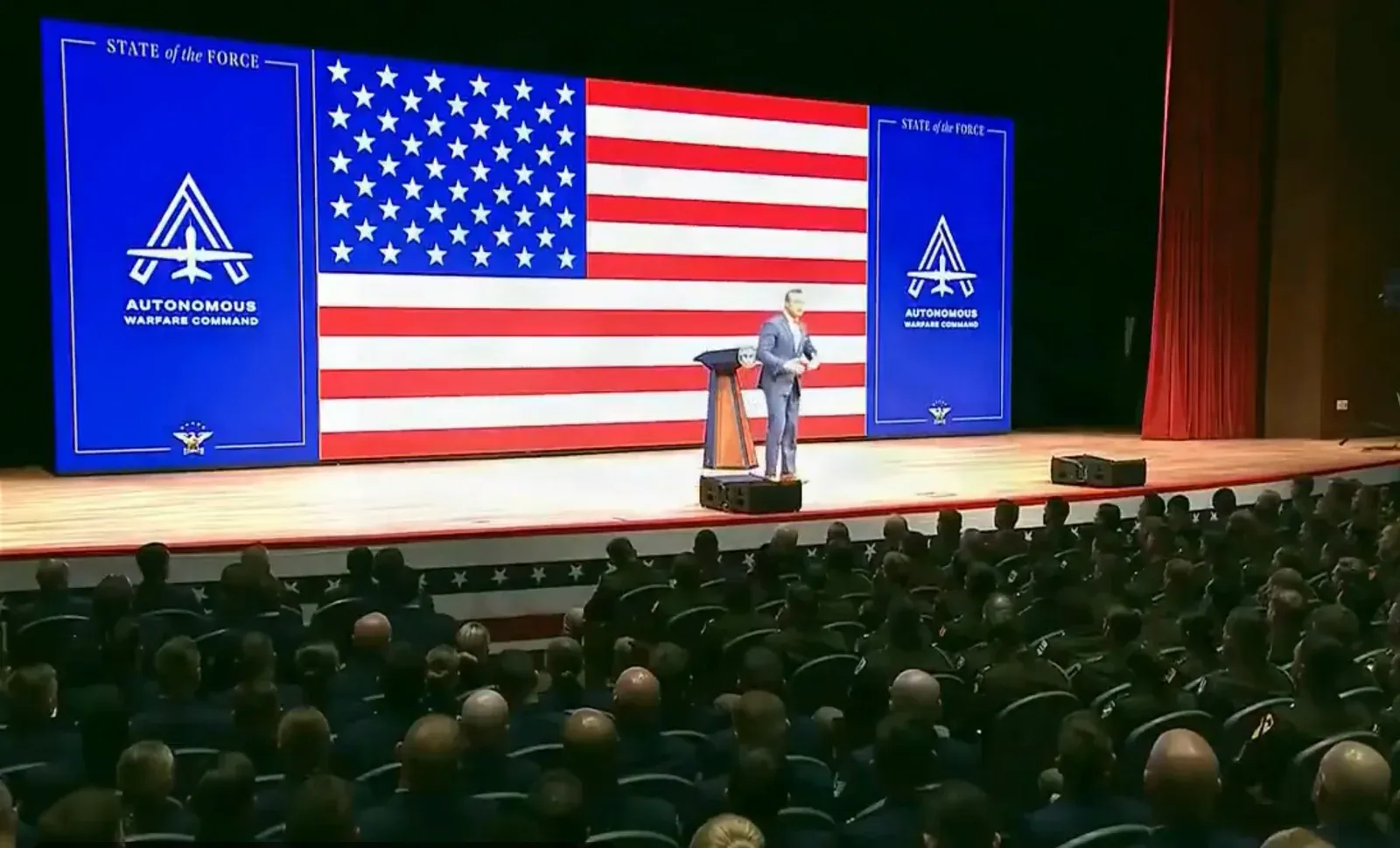
US Defense Secretary Pete Hegseth announced the creation of the Autonomous Warfare Command (AutoWarCom) on September 30, a four-star combatant command meant to scale drones, robotics and artificial intelligence across the entire armed forces. He did so before roughly 600 O-3 officers and E-6 noncommissioned officers at the Marine Corps base in Quantico, Virginia. The target date is October 1, 2027.
According to the Department of War’s release, it will be a functional combatant command with service-like authorities — its own budget and manpower included — and with new military career fields for the people who operate and fight with unmanned systems. It was the first of six announcements in the speech and the only one built around hardware. Until that command exists, an interim effort called Project Agincourt, housed in the Pentagon’s unmanned systems office, is supposed to build the path.
Project Agincourt: the drone office as the command’s builder
The Agincourt memo, signed the same day, assigns the effort to the Direct Reporting Portfolio Manager for Unmanned Systems (DRPM-UxS) and gives it 30 days to submit a plan of action and milestones alongside the chairman of the Joint Chiefs of Staff. That puts the first deadline around October 30.
DRPM-UxS is the office DroneXL followed in July as the Pentagon’s “drone czar,” created on June 29 with milestone decision authority over nearly every unmanned program in the department and a direct line to Deputy Secretary Steve Feinberg. It already runs the Defense Innovation Unit (DIU), the counter-drone task force JIATF-401 and the Defense Autonomous Warfare Group.
Agincourt adds two missions on top of that portfolio. The first is the pathway: organizational shifts, legislation and career tracks for officers and enlisted personnel. The second is a prototype of what Hegseth calls warfighting acquisition. The memo states that the desired output is not a particular drone but a repeatable procurement system that keeps adapting in combat on the right side of the cost exchange. Decisions and dollars move toward combatant commands and frontline units, and systems are tested in exercises and, where possible, in combat.
The name refers to 1415. In Hegseth’s version, the English win with longbows and move their fletchers up to the front to keep the rate of fire going; the “fletchers” in the analogy are engineers and startup founders embedded with operators. Hegseth named Owen West, DIU director since March 2, chief executive of DRPM-UxS for the next year, with Navy SEAL Senior Chief Max Strasiser as chief operating officer. West handles strategic risk, resources and scale; Strasiser handles operational problem-solving and combat employment. West was assistant secretary of defense for special operations and low-intensity conflict and a Goldman Sachs partner, where he ran the gas and power business; he deployed twice to Iraq as a Marine while on leave from the bank. Strasiser is, according to the department, the first enlisted SEAL to graduate from the Navy Test Pilot School.
DIU moved the next morning. On October 1 it named Travis Metz, its deputy director and Drone Dominance program manager, acting director, and said on X that West “steps aside to kickstart Project Agincourt.” Metz came to DIU from the office of the Secretary of War, where he worked on Drone Dominance, after a career in venture capital funds. Inside Defense first reported the handover.
AutoWarCom’s gaps: commander, budget and the law
Hegseth said a four-star commander will be named soon to raise the AutoWarCom flag, but he named nobody. The memo sets no dollar figure, no personnel number and no headquarters, and it conditions the entire structure on legislation that DRPM-UxS is told to go and secure from Congress.
Congress got there first on paper. The Senate Armed Services Committee’s fiscal 2027 defense bill, approved 18-9 in June, creates a four-star Robotic and Autonomous Systems Combatant Command with test and evaluation powers and limited acquisition authority, according to Breaking Defense. That text has not passed, and the Senate’s limited authority is narrower than the service-like authorities Hegseth described. Reconciling the two versions is the legislative work the memo assigns to DRPM-UxS.
The money is already requested. The fiscal 2027 request seeks $75 billion across drones and counter-drone work, most of it routed through the Defense Autonomous Warfare Group that now sits under DRPM-UxS, and Hegseth used the speech to press Congress for a separate $350 billion reconciliation package. Whether AutoWarCom absorbs part of that or gets a line of its own does not appear in any document released this week.
Hegseth framed the whole command around cost. For 40 years, he said, the United States bought quality instead of quantity. “The pace of war is changing faster than the process to support it,” he said, before describing a high-low mix in which exquisite weapons are the lightning and massed attritable drones are the wind and rain of the same storm.
What the move signals
Hegseth’s argument rests on a year of results from Drone Dominance, the program Agincourt takes as its template. It is a $1.1 billion, four-phase buy of one-way attack drones in which military operators fly and score vendors’ aircraft and orders follow the leaderboard. Gauntlet I produced orders for about 30,000 drones. By August 25, the winners had delivered 13,440 of the 22,320 the first tranche required, about 60 percent. Gauntlet II, at Fort Carson in August, ended with Neros signing a $100 million order plus 800 drones its rivals failed to deliver, and the department opened a $450 million Phase 3 round with a 400-drone entry requirement the day before Hegseth spoke. The program bans motors and batteries from China starting in Phase II; whatever AutoWarCom buys will inherit that rule.
The speech also included Project Meridian, a 120-day future-warfare study co-directed by Elon Musk, Palmer Luckey and Newt Gingrich under Chief Technology Officer Emil Michael, to end in a public report with a classified annex. Luckey founded Anduril, which sells drones, counter-drone systems and autonomy software to the department whose future requirements he is now helping to write. The department’s release describes the panel as “the nation’s premier private-sector innovators” and says nothing about recusals or conflict rules.
The delivery gap, more than the org chart, will decide whether AutoWarCom means anything by October 2027. A combatant command with its own acquisition authority can write checks faster, but it cannot make a startup with a China-free supply chain deliver the airframes it was awarded if the motors are not there. Two dates remain to be verified: the 30-day plan around October 30 will show whether the services hand over force structure or just liaison officers; Meridian’s report in late January will show whether a panel led by a drone maker recommends buying more drones. If both land on time, the timeline is credible; if the first slips, raising the flag in 2027 will be a ceremony.