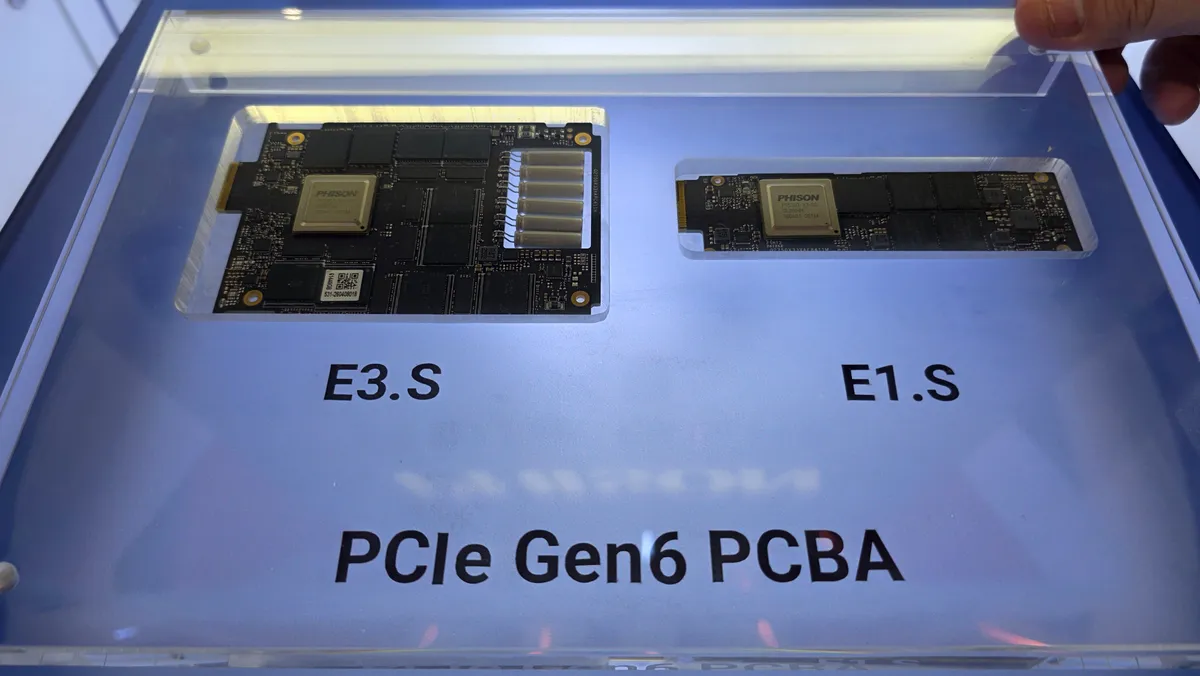
Phison used Supercomputing 2026, held in Chicago from 17 to 19 November, to show two enterprise SSD architectures that address different problems. The first places an NPU and 64 GB of memory inside the drive itself to run AI code on the data where it is already stored. The second puts the pSLC cache and the QLC capacity behind a single controller, so that every server bay provides usable storage instead of being reserved for dedicated cache drives.
One point needs fixing before going further: Phison describes both as technologies in development and warns that many of the announced products and features will arrive when they are finished, without committing to dates. Neither the NPU design nor the mixed-media design has a commercial name, an identified controller or a sampling date, according to Tom’s Hardware. What has been announced is the architecture; what has been demonstrated, for now, are the figures the company publishes in its press release. The announcement was completed by a third line, the PCIe 6.0 X3 controller (PS5303), which Phison places at up to 28 GB/s sequential and 6.8 million IOPS; this piece focuses on the two storage designs.
A 36,800 DMIPS NPU and 64 GB inside the SSD
The computational storage design starts from a simple premise: instead of moving a complete dataset from the SSD to the server memory and from there to the CPU, the drive processes it and returns only the result. Phison puts the saving in transfers at between 10 and 100 times for workloads where filtering or scanning dominates total time, and adds that the processing happens in parallel inside the drive, freeing host processor resources.
The hardware behind that idea comes down to three numbers: an integrated NPU rated at 36,800 DMIPS, 64 GB of memory and 130 GB/s of bandwidth between that compute and that memory. On the software side, the drive claims compatibility with PyTorch, vLLM, OpenVINO and llama.cpp, so a development team can reuse its tooling instead of learning a proprietary environment.

The 130 GB/s is internal, not the link to the server
That 130 GB/s figure is the one most open to confusion, and it is best read with the link arithmetic in front of it. A PCIe 6.0 x4 link, at 64 GT/s per lane, moves at most about 32 GB/s in each direction; a PCIe 5.0 x4 stays at half that. In other words, the throughput Phison announces cannot cross the connector: it corresponds to the internal bus between the NPU and the drive’s 64 GB of memory. The advantage is not that the SSD delivers data to the server faster, but that a good part of the work no longer needs that trip.
That approach also explains the memory size. 64 GB is enough working space to filter, index or preprocess large blocks of data next to the storage, and to host a moderately sized model: an 8-billion-parameter model in FP16 takes up about 16 GB. It is not enough, however, for a large model, and 36,800 DMIPS puts the NPU in the order of magnitude of a modern CPU core, not of a dedicated accelerator. Phison also does not publish TOPS or the numerical precision the compute block supports, two figures that do appear in any NPU datasheet intended for inference.
The idea of moving compute closer to the data is not new in the sector: Kioxia already proposed replacing part of the DRAM with ultra-fast SSDs over CXL, and other manufacturers have shown drives that run the file system inside the drive itself. The difference here is that Phison talks about running complete AI frameworks, not just lightening the storage stack.
pSLC and QLC behind a single controller
The second design answers a deployment problem rather than a compute one. A fast storage server usually reserves part of its bays for high-endurance cache drives and the rest for high-capacity QLC disks, which costs complexity and space. Phison integrates both types of flash in the same drive, spread across 16 channels and governed by a single controller.
The practical argument the company gives is cache resilience. In an array of 24 drives, losing one disk means 4% of the available cache instead of the 25% that would be lost if all the cache lived on six dedicated drives. The design uses standard NVMe and, according to Phison, requires no specific host software, a relevant detail because it avoids changing the server’s storage stack.
What has been shown and what is still an announcement
Separating the two is mandatory with this kind of presentation. The technical breakdown is published and verifiable: 36,800 DMIPS of NPU, 64 GB at 130 GB/s, claimed support for PyTorch, vLLM, OpenVINO and llama.cpp, a 10-to-100-fold saving in transfers for applicable workloads, 16 channels and cache distribution across drives. So is Phison’s warning that everything remains in development.
What is not published, by contrast, is almost everything needed to evaluate the product: there is no commercial name, no identified controller, no sampling date, no latency figures, no power draw, no endurance in TBW and no price. Nor is there a single performance test with a real model, so the transfer saving is a manufacturer estimate and not a measured result. Compared with a consumer SSD review, where sustained megabytes per second and cache limits are published, here there is only architecture and promises.
For a reader with a desktop PC, the announcement changes nothing in the short term: these are enterprise designs, with no product and no sales channel. What is worth following is how the hard part is solved, which is the software. A drive running PyTorch does not imply that the host can reserve that memory, launch the job and collect the result as naturally as with an accelerator connected over PCIe. If Phison publishes that programming model and latency figures under sustained load, computational storage will move from a reasonable idea to something that can be compared; until then, it is a well-explained architecture and nothing more.