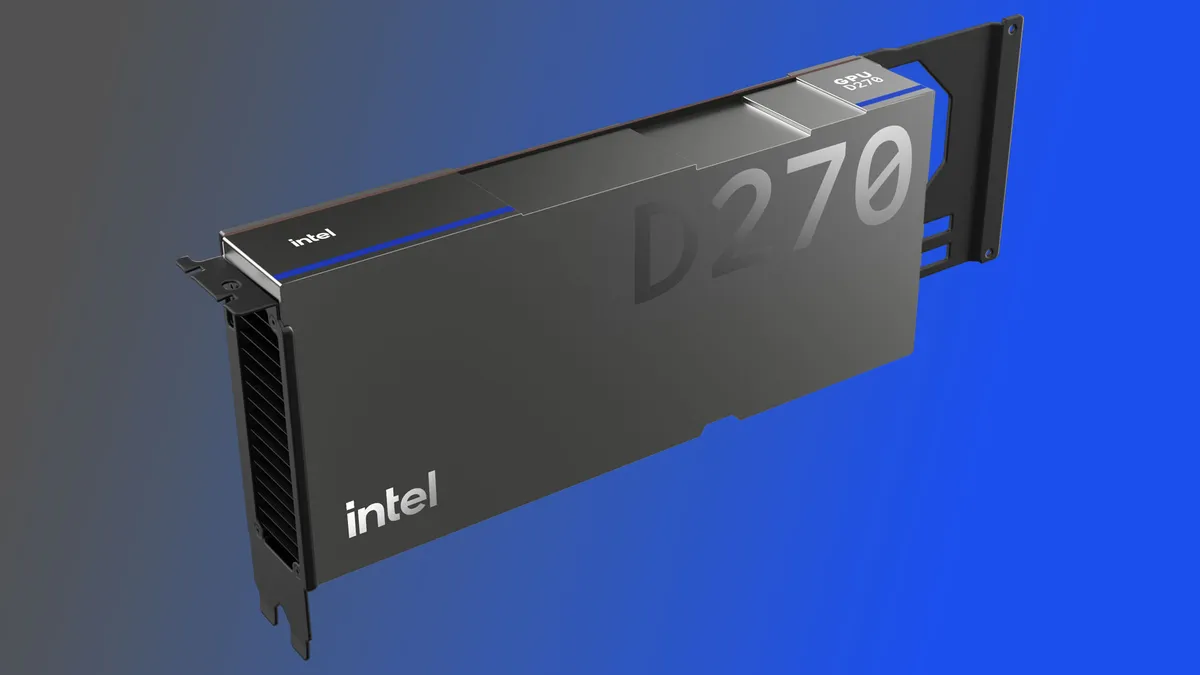
Intel has given its AI inference accelerator, previously known as Crescent Island, a definitive name. At the OCP 2026 event, the company presented it as Intel GPU D-Series and, for the first time, published two figures that had not been detailed until now: a target of 1.3 PFLOPS peak in FP8 and a memory bandwidth of 1.5 TB/s. It is worth clarifying upfront that these are manufacturer theoretical figures, not independently measured results.
A compute accelerator, not a graphics GPU
The GPU D-Series is the first chip built on Intel’s Xe3P graphics architecture. The company itself clarifies the term: according to Tom’s Hardware, the product lacks most—or all—of the dedicated functional graphics units that would characterize a standard GPU, so in practice it functions as a massively parallel compute architecture oriented toward AI inference.
The multinational had already advanced other key features of these products: they will come in PCIe format with air cooling, with a TDP of 350 W and up to 480 GB of LPDDR5X memory.
What the two new figures contribute
The two specifications confirmed at OCP 2026 are peak performance and memory bandwidth. The first (1.3 PFLOPS in FP8) defines how much reduced-precision compute capacity the chip can offer; the second (1.5 TB/s) marks the speed at which that capacity can be fed data. In inference loads with large models, moving weights from memory is usually the bottleneck, so the bandwidth figure matters as much as raw power.
Both figures are manufacturer targets, not results measured in independent tests, and they add to the gradual revelations Intel has published about Crescent Island throughout 2026.
What changes for the reader
What was announced at OCP 2026 places the GPU D-Series in the realm of data center inference, not consumer graphics cards. There is still no price, availability date, or measured comparison against alternatives with which it will compete in that market.
For a buyer or an integrator, the decision remains just as open as before the announcement: the published data defines the product’s theoretical ceiling, but without a price per unit of compute or real performance figures, it is not possible to assess its cost/performance ratio. The reference that counts is not a previous generation from Intel itself, but the accelerator that truly occupies its segment when both are on sale.