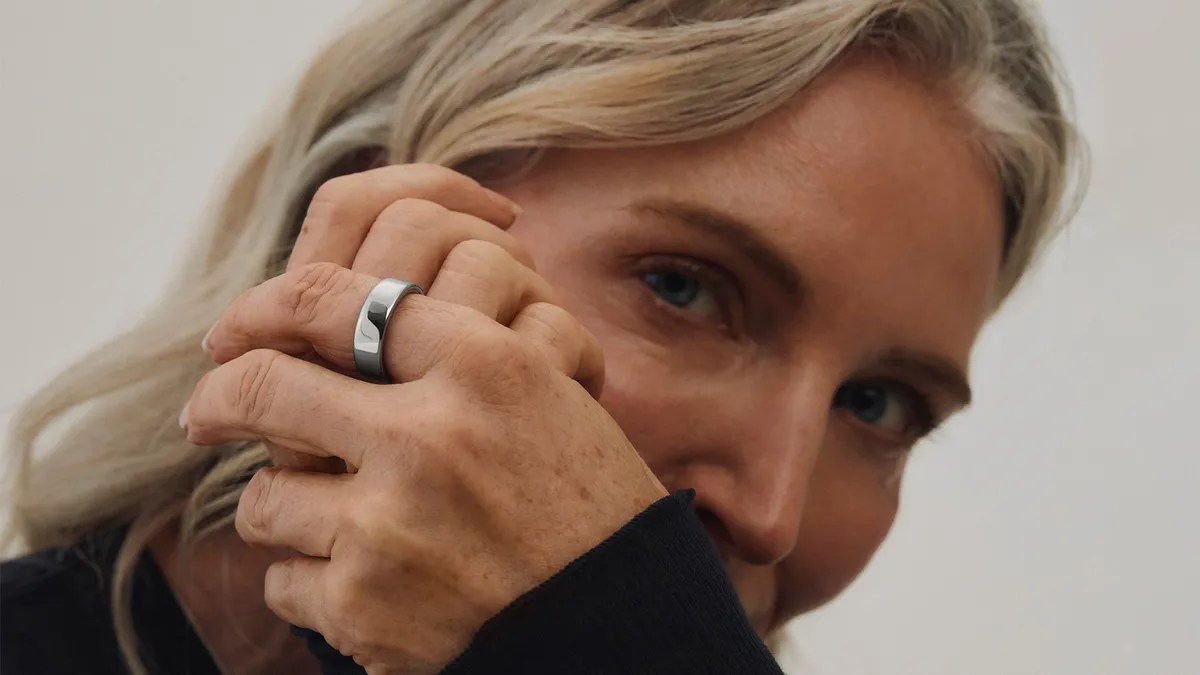
Oura has struck a partnership with Xella Health, a US women’s precision health platform that combines lab testing with remote medical care. The integration changes neither the ring nor its sensors: what changes is at the other end, in what each person decides to do with the data the device already records. Anyone with an Oura ring in the United States who pays for an Xella subscription will be able to send their metrics straight to the platform.
The idea is for the ring to spot the change and Xella to try to explain why. The ring is good at showing that something has moved — a worse night’s sleep, a temperature outside the usual range — but it cannot interpret it. That is where the clinical side comes in.
Which Oura ring data goes to Xella Health
A person who subscribes to Xella can authorise the sharing of sleep, heart rate variability (HRV), resting heart rate, temperature trends, recovery, activity and menstrual cycle data. In practice, these are the core metrics the ring already tracks.
With that material, Xella runs what it calls “multi-omic” diagnostics: its own AI model analyses the ring’s physiological data alongside hormones, metabolism, inflammation, nutrition, reproductive health and cardiometabolic risk to look for patterns that may point to a change in health status. In other words, it crosses what the ring sees daily with lab work the ring cannot measure.
From there, the platform builds a care plan together with a doctor, with treatment for more than 130 conditions that affect women, such as endometriosis. The partnership targets fertility, perimenopause, cardiometabolic health, hormonal health and women’s longevity.
“Wearables have transformed our ability to detect physiologic change,” said Kelly Lacob, CEO and co-founder of Xella Health, in a statement. “By combining continuous data and insights from Oura with Xella’s molecular diagnostics and clinical care, we’re creating a more complete picture of women’s health.”
Why it matters
The move fits a clear trend: screenless rings and bands are no longer sold only as wellness trackers and are looking for a place in the clinical pathway. The difference from any ordinary tracking app is that there is a lab and a doctor in the middle. If the ring’s data is combined with blood tests, a shift in the readiness or sleep score can be read as a signal worth investigating rather than as a lone number.
It is also worth putting it in context against the competition. Whoop opened its blood-testing and cancer-screening service to people who do not wear its band, and Oura had already partnered with the women’s health app Natural Cycles. Xella gives Oura a clinical, women-focused answer. Another sign of that race for screenless health tracking is the band Qalo added to its smart ring.
Price, coverage and limits
Xella is a separate subscription, on top of the cost of Oura: $499 a year. It is available in every US state except New York and New Jersey, so for now it is out of reach for Spanish-speaking audiences in Spain and Latin America.
The Oura Ring 5 starts at $399 and adds $5.99 a month for the subscription. Before weighing the jump, two things are worth remembering: Oura insists its ring is not a medical device, and the screening of more than 130 conditions is a Xella claim built on its own diagnostics, not something the ring detects automatically. The evidence behind this kind of device’s readiness scores is thinner than the marketing suggests.
What to consider before you decide
If you already wear an Oura ring, live in the United States and want to cross your daily metrics with lab work and a doctor’s judgement, Xella’s pitch makes sense: it is exactly the step the ring is missing. If all you wanted was a device that measures sleep and recovery well, you do not need a $499-a-year clinical layer you are unlikely to use.
And if what you want is women’s health with medical backing and coverage outside the United States, this integration will not help you today: we will have to see whether Oura and Xella extend it to other markets and whether their clinical results are published and reviewed.