Cherry Audio Revives the Gleeman Pentaphonic, a Polyphonic Synth from 1981 with Fewer Than 70 Units in Existence
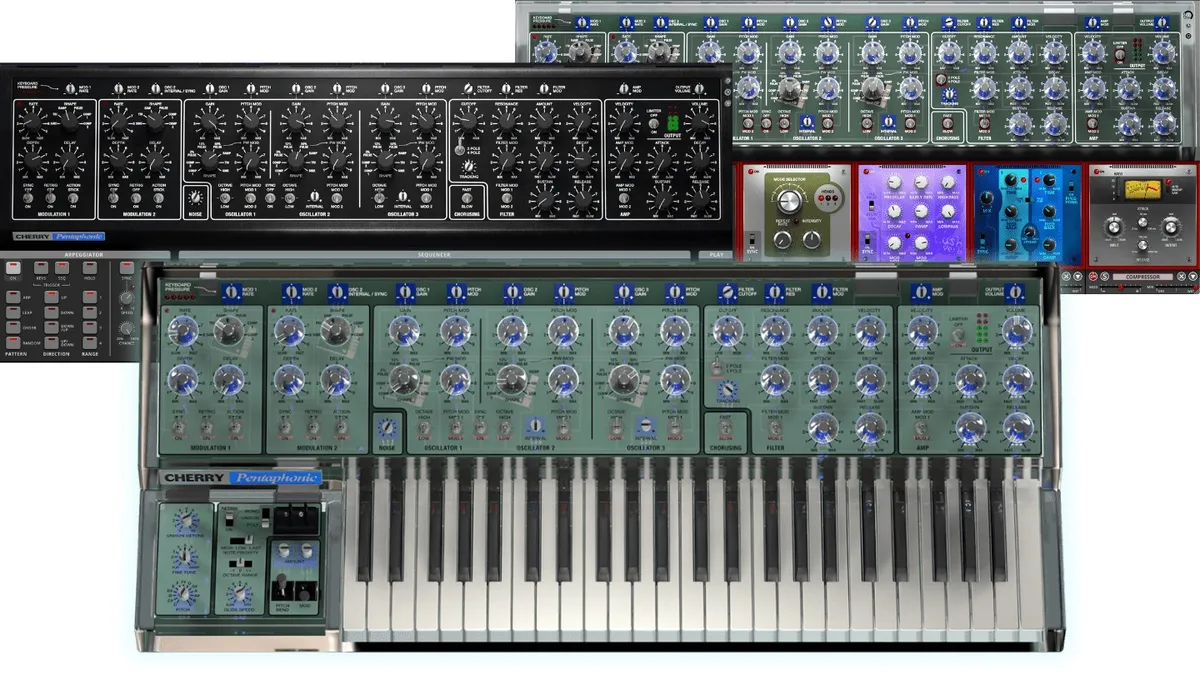
Cherry Audio has released Pentaphonic, an emulation of the Gleeman Pentaphonic, a polyphonic synthesizer from 1981 of which fewer than 70 units were manufactured. The plugin costs $59, runs on macOS and Windows, and takes the original design as a starting point to expand it with more polyphony, a second LFO, a step sequencer, and an effects section.
A Polyphonic Synth Born in a Garage
The Pentaphonic was designed by brothers Bob and Al Gleeman in a garage in Mountain View, right in the heart of Silicon Valley. It was a five-voice instrument with fifteen digitally controlled oscillators (DCO), three per voice, supported by Intel microprocessors to maintain stable tuning. Each oscillator offered eight waveforms, two described as complex due to their harmonic richness, and the filter was the four-pole Curtis CEM 3320—the same integrated circuit that appeared in other polyphonic synths of the era. The ensemble was completed with a 37-note keyboard, a 300-note polyphonic sequencer, an integrated speaker, and a handle, at a price hovering around $3,000.
According to the history accompanying the launch, about 30 black units were hand-assembled. In 1983 came the Pentaphonic Clear, with a transparent acrylic case that revealed the electronics, optional interior lighting, a two-axis joystick, 100 programmable memories, and a 600-note sequencer; around 20 were built at approximately $3,400 each. In 1994, David Kean of the Audities Foundation purchased the remaining inventory of parts and assembled, as recounted, another fourteen units across both versions. Despite that scarcity, names like Oscar Peterson—who took a Clear just after seeing it—Martin Gore of Depeche Mode, R.E.M., The Band, or Kansas passed through its hands.
What Pentaphonic Adds to the Original Design
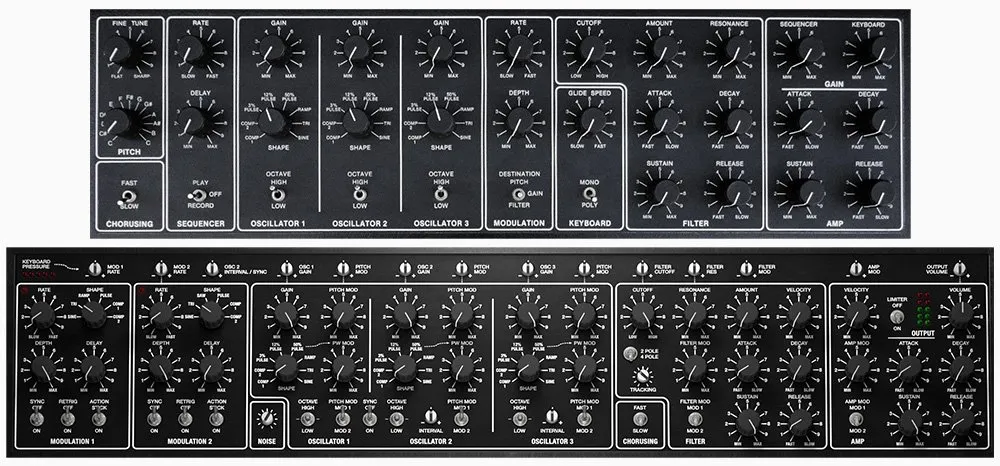
The base remains faithful: stepped waveforms on the oscillators, a four-pole filter, and the two-speed chorus of the original. From there, Cherry Audio introduces changes oriented toward current use:
- 2 to 16 voices polyphony, with monophonic, polyphonic, and unison modes with detuning.
- Oscillators with pulse-width modulation, sync, and noise generator.
- Second LFO, both with the eight waveforms.
- Filter with an additional two-pole mode (12 dB per octave) and keyboard tracking.
- Expression via velocity on filter and amplifier, plus assignable channel and polyphonic aftertouch to 14 parameters.
- Arpeggiator with four modes and a polyphonic sequencer of 16 steps with four chainable patterns, syncable with the DAW.
- Parameter Animator, a 16-step modulation sequencer for cutoff, resonance, tone modulation, and oscillator level.
- 22 effects, up to five in a chain.
- Three interface aspects: black, transparent, and a transparent variant with adjustable opacity.
The plugin includes more than 375 presets distributed across 14 categories, including the 50 factory presets from the original instrument.
Price, Formats, and Availability
Pentaphonic costs $59 and offers a free 30-day demo. It is distributed in AU, VST, VST3, and AAX formats, plus a standalone application. It requires macOS 10.13 or later, with support for Intel and Apple silicon, or Windows 7 or later on 64-bit.
Is it worth it? For those seeking the character of a polyphonic synth that is now practically unfindable, the emulation is the most affordable way to get close to it, and its feature list far exceeds what the hardware offered. It should be remembered that this is a software recreation: it does not replace a physical unit, but puts its sound within reach for much less than the Clear cost in 1983.