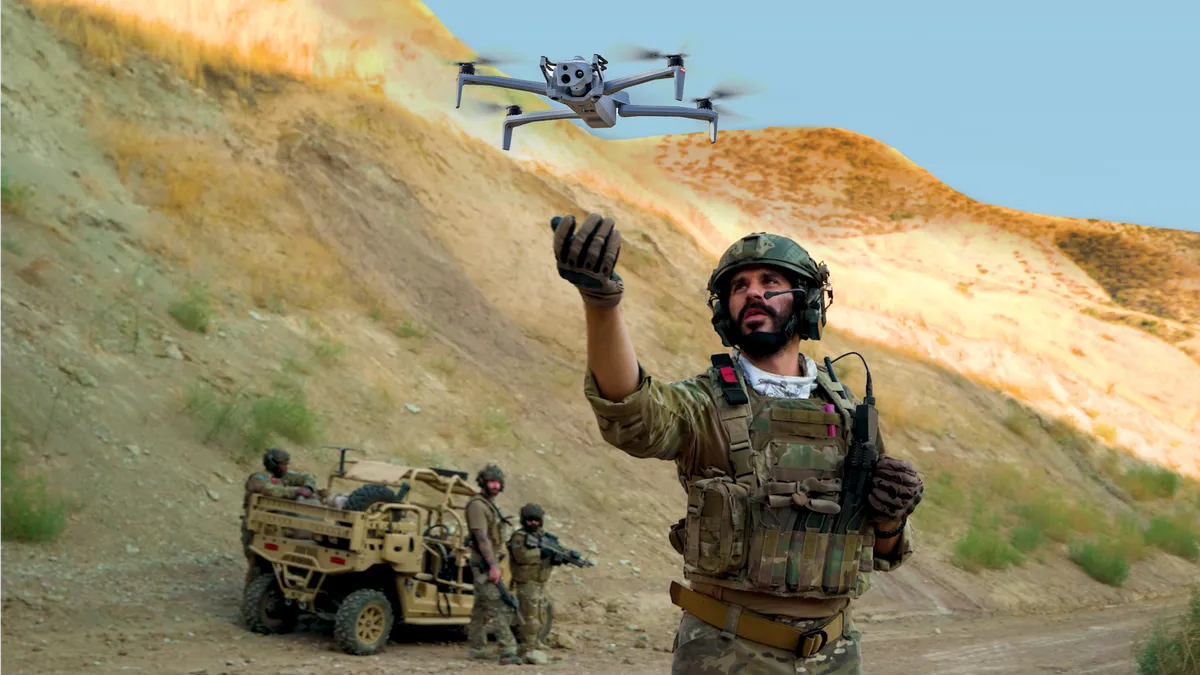
The U.S. Army has awarded $4.15 billion in anti-drone contracts to ten companies. These awards fall under Domestic Shield, the Department of Defense initiative to strengthen protection of military bases and critical infrastructure against cheap drones, and do not tie purchases to a single supplier: the framework allows orders up to a cap of $7.0 billion.
Ten Suppliers and a Cap of $7.0 Billion
Seven companies receive contracts with a base value of $500 million each: Allen Control Systems, Digital Force Technologies, DroneShield, L3Harris WESCAM, Napatree Technology, RADA Technologies and SRC. Echodyne and PVP Advanced EO Systems get $250 million apiece, and Smart Shooter rounds out the list with $150 million. The sum of the base awards adds up to $4.15 billion, but the full agreement supports up to $7.0 billion.
The structure is that of a multi-supplier market, not a closed order. That allows military branches, federal agencies and allied partners to purchase commercially available anti-drone systems through a single contracting vehicle instead of resorting to separate purchases. Keeping multiple manufacturers in play is also the way to maintain competition and avoid dependence on technologies controlled by a single provider.
The program is administered alongside Joint Interagency Task Force 401, the Pentagon unit that coordinates response against unmanned aerial threats. The award does not close the list: officials expect more contracts below the established threshold before October 2026 ends, leaving other suppliers with an option to enter as purchases advance.
What Is Being Purchased and Why Open Architecture Rules
The contracted technologies cover much of the defense supply chain: robotic weapon stations, rifle optical sights, compact radars, long-range tracking cameras and command-and-control software. Each family solves a different task—detecting the threat, tracking its trajectory, supporting response—so coordination between teams from different manufacturers becomes a requirement, not an extra.
To sustain that coordination, the Army requires systems to meet open architecture standards and connect with existing defense networks. “This multi-supplier market imposes strict open architecture standards, breaks proprietary manufacturer lock-in and ensures new technologies can be integrated immediately into our defense networks,” summarizes Brent Ingraham, Deputy Secretary of the Army for Acquisition, Logistics and Technology.
From the Iranian Threat to the Cost per Interception
The urgency of these systems became more visible during the war between the United States and Iran in 2026, when Iranian drone attacks damaged U.S. facilities and materiel in the Middle East. On March 3, 2026 two unmanned aircraft struck the U.S. embassy in Riyadh (Saudi Arabia), with material damage estimated at around $11.5 million. Other attacks hit a fuel depot and damaged an Army asset in Kuwait, while actions continued against power plants and desalination plants after the ceasefire. In Saudi Arabia Iranian drones hit a CIA station in Riyadh and, within a week, left 29 U.S. military personnel injured.
The Congressional Research Service calculated that 81 U.S. aircraft and drones were destroyed or damaged during the conflict, with potential losses up to $3.3 billion. Many of those attacks were executed with swarms of cheap drones, and there is the knot of the problem: intercepting a low-cost aircraft with expensive munitions pays off per unit shot down but unbalances the account per interception. The Pentagon directed energy pilot, with lasers and microwaves over U.S. bases, points at the same target from another angle.
What Changes With This Framework
Domestic Shield does not buy systems all at once: it enables the vehicle to purchase them when need tightens. That shifts the question from design to production and operating cost, and explains why the same market that distributes these $4.15 billion also feeds the private detection business, where Echodyne’s round and Fortem’s purchase showed radar is today the most mature segment.
The question, as in any framework contract, is not how many millions are signed but how many are ordered. A cap of $7.0 billion only becomes real capacity when bases start ordering units and systems demonstrate they hold up in service without firing the cost per kill.