Cleveland Heights, Ohio, Mayor Jim Petras is scheduled to meet Amazon next week. The reason is the route taken by the Prime Air drones operating out of the North Randall warehouse since September 24: as he told Spectrum News 1, the aircraft fly over residential neighborhoods, and his aim is to ask the company to adjust its flight pattern and shift it toward a commercial area.
Cleveland Heights sits inside the 12-kilometer (7.5-mile) delivery circle Amazon draws around its North Randall facility. The city does not host the hub, but it does receive its overflights.
What Cleveland Heights Is Asking Amazon For
Residents’ complaints are nothing new in eastern Ohio. Some neighbors describe a sound like a swarm of bees or a lawn mower, and one of the concerns they add to the noise is surveillance: they fear a foreign aircraft flying over their homes and that someone could fly a drone identical to Amazon’s.
Petras’s specific request is limited in scope. He is not asking for the service to stop, but for departures from North Randall to stop crossing rooftops and move toward commercial land. That is the margin a city council can negotiate, because it does not control the airspace: that authority is federal, and Amazon’s hub is in North Randall, not Cleveland Heights.
The Richardson Precedent
Amazon has already made a smaller version of that change. In Richardson, Texas, it rerouted some departures over a commercial area after residents complained. The company implemented the changes in February and presented them to the city council on March 9, according to Community Impact: it raised the minimum altitude for outbound flights to an average of 69 meters (225 feet) and sent some departures east, over a commercial area, before entering a neighborhood.
Residents asked for more: routes over major roads instead of over homes. Sam Bailey, who presented the changes for Amazon, ruled it out. He argued that flying over roads adds a safety problem and uses far more energy, and that reducing the aircraft’s noise would require a hardware change that is not coming soon.
The regulatory margin is narrow on altitude as well. In Baton Rouge on September 9, an Amazon spokesperson recalled at a public event that any altitude change needs approval from the Federal Aviation Administration (FAA). It is the same barrier that limits what Cleveland Heights can demand without going through Washington.
Noise, Privacy and the Package Drop
The figures the FAA itself handles for the MK30 in its Baton Rouge filing help size up the noise. In the delivery phase the drone produces about 69 decibels Lmax measured 23 meters (75 feet) from the drop point, a level the agency likens to a household vacuum cleaner at 10 feet. Its maximum is 92.1 decibels SEL at 8 meters (25 feet), with a diesel truck at 50 feet and between 80 and 90 decibels as a reference. Amazon maintains that its fully electric drones are quieter than an idling delivery truck during a drop-off.
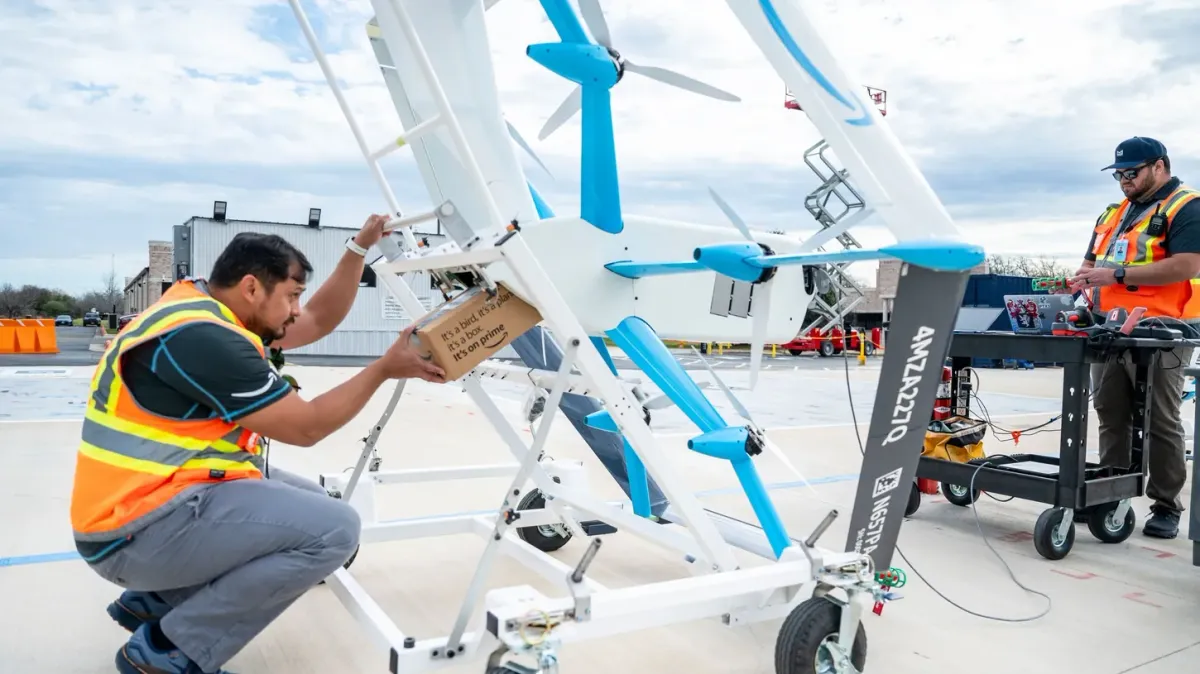
The MK30 descends to about 4 meters (13 feet) over the drop point, hovers and releases the box. One customer, Shaunese Reese, said her package arrived the next morning in good condition, but that the landing was not perfect: the box fell and rolled down her driveway, which in her view makes it easier to steal. In Richmond, Texas, that same release system left an order in a swimming pool in August. Zipline, by contrast, lowers packages on a tether.
On top of delivery safety comes the camera. Prime Air’s operations page, checked by DroneXL on October 6, states that people who are near a delivery or landing spot may be recorded, and lists people, pets, cars and objects near the location among what the cameras may capture. Amazon maintains that the drones use cameras and sensors to navigate, detect obstacles and deliver safely, but that they do not track individuals or record their movements.
Not all the traffic over eastern Cleveland is Amazon’s. Shaker Heights officials confirmed that delivery drones for both Amazon and Cleveland Clinic fly in the area, according to 19 News. The clinic’s Zipline prescription service operates from Beachwood, about 5 kilometers (3 miles) northeast of Amazon’s warehouse, since it launched in August. The city noted that the FAA regulates those flights and that it is still gathering information.
What Changes for the Reader
For a resident of the Cleveland metro area, next week’s meeting matters less for what the city council decides than for what Amazon offers. In Richardson the company did move some of its flights after neighborhood pressure, so a route change in Cleveland Heights is not out of the question; but it also rejected routes over roads then, and in Baton Rouge it made clear that raising altitude depends on the FAA.
The likely outcome, then, looks like a partial adjustment: departures over commercial land where possible, with the operation intact and no substantial reduction in noise in the short term. The MK30 weighs about 38 kilograms (83 pounds) at takeoff and carries no parachute, against roughly 25 kilograms (55 pounds) for Zipline’s aircraft, which does carry one: they are two different philosophies of aerial delivery over the same residential areas. The question left on the table is whether that adjustment is enough for the neighbors who never asked to have anything flying over their homes.
An earlier case of the same kind, the neighborhood rejection of Amazon’s Westborough hub, showed that local opposition can delay an operation even without authority over the airspace.