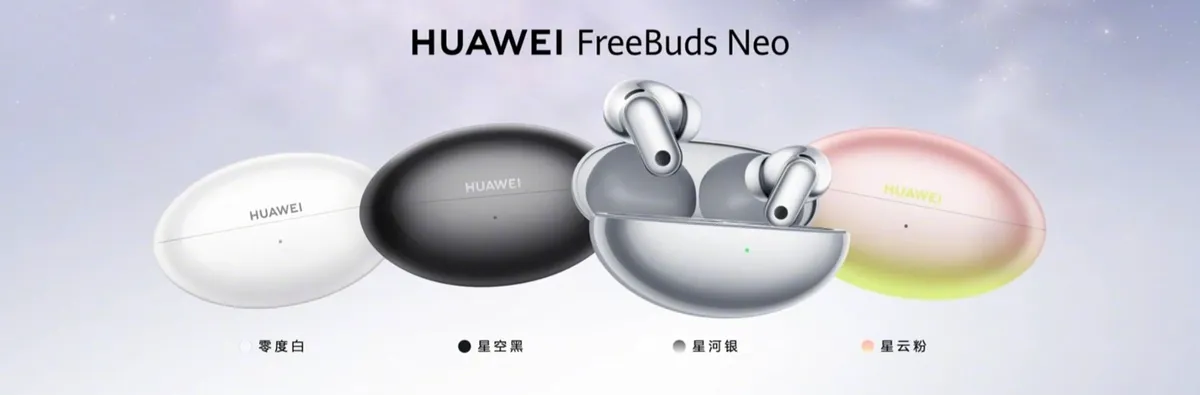
The Huawei FreeBuds Neo are now official. The company unveiled them at the same event where it announced the Mate 90 series, priced at 699 yuan, which for now applies to the Chinese market. The pitch rests on two figures: a third-generation audio AI chip developed in-house by Huawei and active noise cancellation that the firm puts at an average of 30 dB across the range.
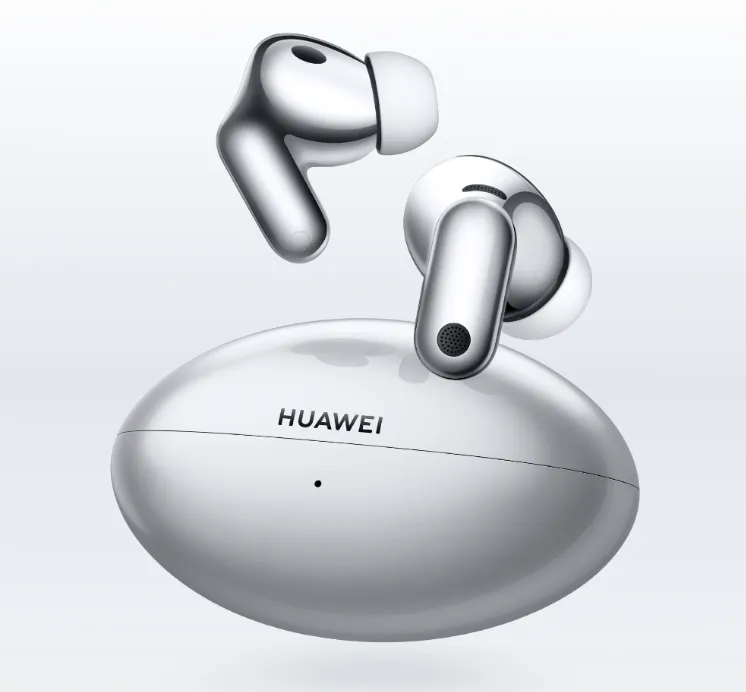
The case is a single curved body with a 31-degree side angle, a weight of 41 grams and a width of 41.22 millimetres. The earbuds use a stem format, weigh around 4.8 grams each and, according to Huawei, their curve has been rebuilt in eight dimensions from more than 10,000 ear samples to spread pressure more evenly. They come in four finishes —white, black, silver and pink— with IP55 dust and water resistance and TÜV Rheinland hearing protection certification.
What the FreeBuds Neo’s audio AI chip does
The heart of the system is a third-generation audio AI chip that pairs two DSPs with an NPU processor. Huawei puts the intake of ambient noise information at 400,000 times per second and the processing latency at 8 microseconds, two figures that point to how quickly the system can react before noise reaches the ear.
The cancellation scheme uses two paths: a feedforward path handles the voice band, while a feedback path analyses residual noise inside the ear with an IMC algorithm and corrects it in real time. The earbud’s structure changes too, with a C-shaped tube and an air intake that reshape the wave path to cut internal reflections; this targets mid and high-frequency noise and wind. Huawei says the approach avoids the pressure jump in the ear when switching scenarios.
For calls, the manufacturer claims 95 dB of two-way cancellation, with three microphones and a bone-conduction microphone. There is also a conversation mode that does not require taking the earbuds out: when you start talking they switch to transparency mode on their own and restore cancellation when you finish.
Audio, connectivity and battery life
The driver is an 11 mm Turbo dynamic unit with four magnets, backed by a rear vent structure with multiple openings and a lightweight rigid diaphragm. The claimed response runs from 10 Hz to 48 kHz, and the set carries Hi-Res and HWA certification. On codecs it supports LDAC up to 990 kbps and, paired with a Huawei phone, up to 2.3 Mbps with 48 kHz/24-bit sources. It adds device-independent spatial audio and high-resolution spatial audio within the HarmonyOS ecosystem, with head tracking and support for the Audio Vivid ecosystem.
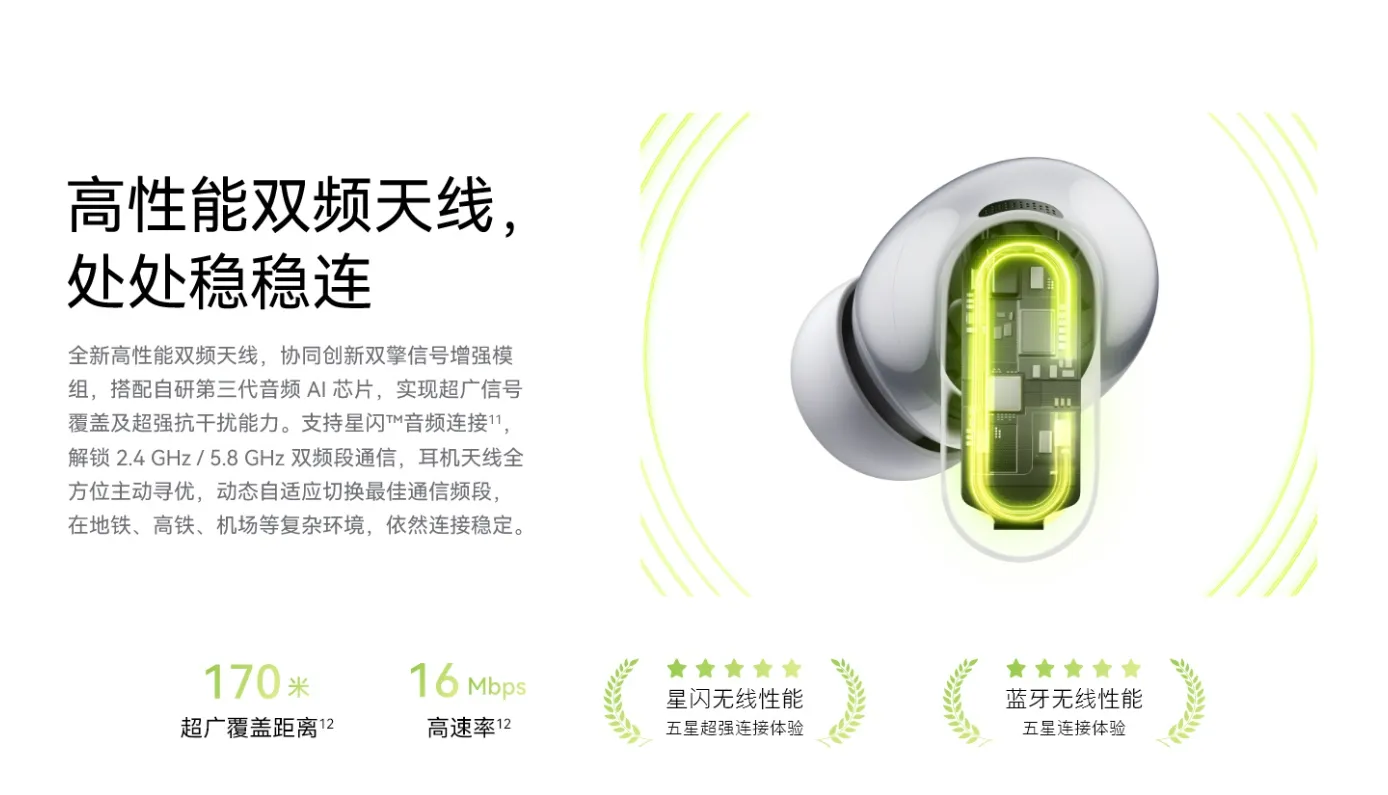
For connectivity, the FreeBuds Neo use NearLink technology and a dual-band antenna that Huawei puts at 170 metres of range and stable coverage in 100 m² indoor spaces, even through walls. They also support handoff between two devices. Claimed battery life is 10 hours per charge without cancellation (40 with the case) and 6.5 hours with active cancellation (24 in total). For gaming, the dedicated mode lowers end-to-end latency to 43 ms in compatible titles, with a sound profile tailored to FPS gunfire and a connection lock to the device in use. The Xiao Yi and Doubao assistants can also be triggered by voice or a long press, with smart notifications, quick notes and multilingual translation.
What changes for buyers
On paper, the FreeBuds Neo compete in the mid-to-high-end active noise cancellation bracket, a field where an average of 30 dB is already a notable isolation figure. The fair question is not the spec sheet but how much of that performance holds up outside the Huawei ecosystem: the 2.3 Mbps over LDAC depends on a phone from the brand, and so does the full spatial audio experience.
On the same day, Samsung unveiled its Galaxy Buds On, clip-on earbuds with a different approach to fit, which makes it clear that this season’s contest is not just about cancellation but about shape and fit. At 699 yuan in China, it remains to be seen at what price and in what version they reach Spain should Huawei decide to bring them over.