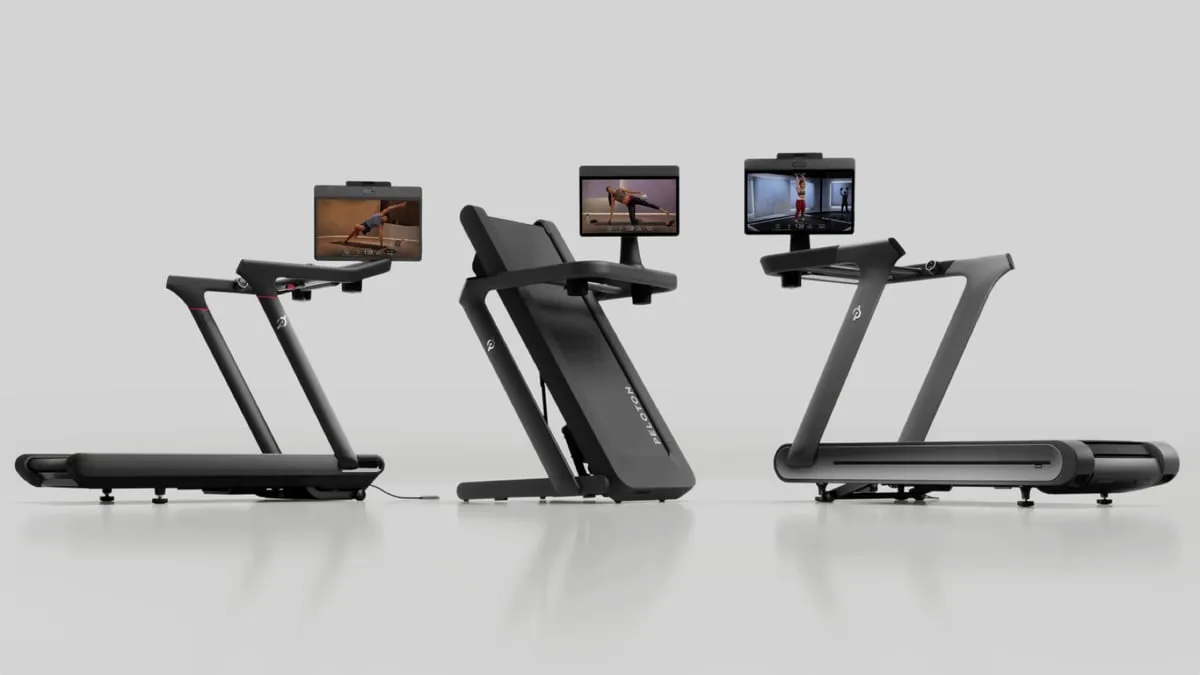
Peloton has overhauled its entire treadmill lineup with three new models and a software layer that, for the first time, genuinely talks to the rest of the runner’s ecosystem. The feature you will notice most day to day is not a treadmill: it is the two-way Whoop sync, which moves workout strain and recovery scores between both platforms. It is joined by a foldable treadmill built for small apartments and a computer-vision system for form correction.
A Peloton treadmill that folds in half
The Peloton Tread Flex ($2,195 / £1,999) is the brand’s first foldable treadmill. When folded, it shrinks by nearly 50 per cent, so it is aimed squarely at small apartments and homes where the machine shares space with everything else. It uses a brushless motor that, according to the company, stays at 70 dB even at its top speed of 12.5 mph.
The announced availability is North America first, on October 1, before reaching the UK and the rest of Europe next spring. It is the most affordable of the trio and the only one that drops form analysis to bring the price down.
Camera and stride analysis: Tread Vision and Tread+ Vision
The Tread Vision ($3,495 / £2,999) steps up a level: it packs an integrated movement-tracking camera and is Peloton’s first computer-vision-enabled treadmill available outside North America. It offers real-time form correction during off-tread strength sessions, plus post-run biomechanical feedback on screen. Its announced global on-sale date is also October 1.
At the top sits the Tread+ Vision ($6,695, with no listed UK price in the published information), aimed at endurance athletes, Hyrox participants and functional-fitness fans. It pairs a shock-absorbing slat belt with the same computer-vision features and a Sled Mode that supplies up to 300 pounds of push resistance for power and stride work. It also launches on October 1.
Peloton IQ: from isolated metrics to connected training
All three machines share the expanded Peloton IQ suite. Run Analysis calculates a running efficiency score from continuous cadence, vertical oscillation and stride length. IQ Pace Targets suggests interval speeds tailored to the runner’s history, and Heart Rate Zone Workouts uses real-time biometric streams from connected wearables to structure cardiovascular training.
The feature that reaches furthest into other ecosystems is ReRuns: it imports outdoor route elevation profiles from Garmin and Strava to replicate real-world hill climbs on the belt. On top of that, the two-way Whoop sync passes workout strain and recovery scores between the two platforms — exactly the ground we covered when we looked at the gap hanging over readiness scores.
In its first hands-on demo in Berlin, Wareable describes the Peloton IQ interface as crisp and the form feedback as intuitive, though it admits a long-term test is still needed to judge how the sensors behave in real use.
What changes for you
If you train at home and space is your main obstacle, the Tread Flex is the sensible pick of the launch: foldable, cheaper and without the form analysis that, if you have never asked for technical correction, you probably will not miss. If you already train intervals and want stride data, the Tread Vision makes more sense than the Tread+ Vision unless you compete or do Hyrox and need Sled Mode.
That said, the Whoop integration only adds value if you already live inside that ecosystem; Garmin or Strava covers route import but not the recovery exchange. And none of the three is an impulse buy: these are home-gym prices. If your doubt is about a watch rather than a treadmill, you may be better off comparing which training truly improves VO2 max before deciding where to spend.