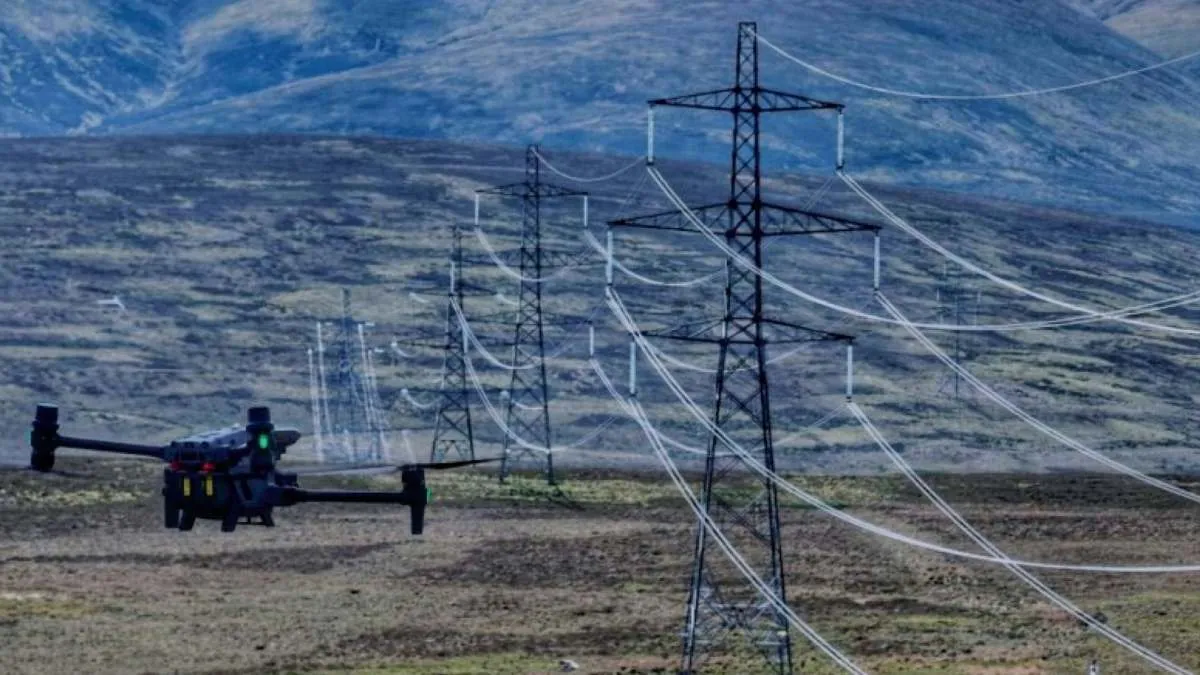
Cyberhawk has signed a new multi-year agreement with SSE’s regulated electricity network businesses, SSEN Transmission and Distribution, to keep inspecting and surveying the company’s infrastructure in mainland Britain with drones. The contract runs for three years, with an option to extend it by another two, and is no longer limited to power lines: the company has also been awarded Lot 2 for offshore wind turbine inspection.
What drones inspect across a grid of thousands of miles
Britain’s electricity networks stretch for thousands of miles of power lines, substations and nodes connecting homes, businesses and renewable energy projects. Inspecting that infrastructure on foot is slow and, along many stretches, dangerous: towers at height, difficult terrain and live assets. Cyberhawk’s approach is the one already common in the sector: the drone captures the state of the asset from the air and spares a crew from having to physically get close to check it. The company has been working with SSE on that task for more than a decade.
The change in scope comes with the award of Lot 2, which takes its flights to SSE’s offshore wind turbines. Inspecting offshore wind farms brings its own difficulties: access by sea, narrow weather windows and a growing number of turbines to review. That is precisely the scenario where unmanned flight cuts boat hours and staff exposure.
From flight to data: the economic argument
The other pillar of the agreement does not fly. Cyberhawk has also renewed its multi-year contract for iHawk as a Service, its infrastructure intelligence platform, which turns inspection imagery into a centralized digital record: photographs, geospatial information and AI-assisted analytics organized by asset. For a utility, the difference lies in not having to sift through millions of images by hand to decide what to repair first; the system groups findings by asset, flags risks and orders the follow-up work.
The interest in combining sensors and analysis is not unique to the power grid: drones fighting wildfires now carry LiDAR to perceive the terrain when smoke blocks the camera.
The context: £33 billion and a third agreement
SSE plans to invest £33 billion (about $43.75 billion) in energy infrastructure by 2030, which multiplies the assets that will need to be inspected and maintained. For Cyberhawk — whose CEO, Chris Fleming, noted this is the third major long-term agreement with SSE after two previous five-year deals — the business is not in the one-off flight, but in repeatable, data-backed inspection.
Is it worth it? For a network operator, yes when the goal is to keep coverage across thousands of miles without multiplying the crews. The limit remains the same as in any aerial inspection: the drone captures the data, but the decision — and the repair — depend on the software turning those images into useful work orders.